
- PVC jackets are cheaper and adequate for indoor / light outdoor use. Rubber jackets (EPDM, neoprene, TPE) survive cold, oil, UV, abrasion, and repeated flexing where PVC cracks, splits, or stiffens.
- Below -10 °C, PVC stiffens to the point of jacket cracking at any bend or impact. EPDM rubber stays flexible to -40 °C; cold-rated TPE to -50 °C.
- In oil and grease environments, PVC swells and degrades; oil-resistant rubber (CPE, neoprene) is the practical requirement, not the upgrade.
- The jacket designation on the cord (SJTW, SJEO, SJOOW, SOOW, SEOW) encodes the jacket material, the temperature rating, and the oil and water resistance — read the jacket stamp before specifying.
The Cord That Failed at the Wrong Moment
A roofing contractor in northern Sweden had been buying 100 ft PVC-jacketed outdoor extension cords from a regional distributor for the spring-through-autumn season. The cords worked fine until the first week of October, when the overnight temperatures dropped below freezing. By the end of the second cold snap of the season, four of the eight cords on site had visible cracks at the plug end and at every bend point where the cord had been coiled. The contractor swapped them for rubber-jacketed cords at slightly higher unit cost. Two seasons later, the original PVC cords were in the scrap bin; the rubber cords were still on the truck. The price difference between the two purchases had been recovered in the first winter.
The PVC jacket vs rubber jacket choice on an extension cord looks like a small decision on a procurement quote. In practice it determines whether the cord is in service or in the scrap bin after the first season of the conditions it was not designed for. This article is about what each jacket material does under stress — cold, heat, oil, UV, abrasion, impact, and flame — and how to read the jacket designation on the cord before specifying.
What the Jacket Stamp Tells You
An extension cord carries a jacket stamp (or printed text) that names the cord type designation. The designation is standardized under UL 817 and CSA C22.2 No. 21, and it encodes the jacket material, the temperature rating, and the resistance to oil, water, and sunlight. Reading the designation correctly is the first step in choosing between rubber and PVC.
The most common cord designations and what they mean:
- SJTW — PVC jacket, 300 V, thermoplastic, weather-resistant. The “W” suffix means the jacket is rated for outdoor use and resists sunlight and moisture. Suitable for general outdoor use in mild climates; the upper temperature rating is 60 °C; cold flexibility is limited to about -20 °C before the jacket begins to stiffen.
- SJT — PVC jacket, 300 V, indoor rated. No weather resistance. Suitable for indoor use only.
- SJEO — TPE (thermoplastic elastomer) jacket, 300 V, oil-resistant elastomer. Better cold flexibility than PVC and oil resistance for light industrial use.
- SJEOW — TPE jacket, weather-resistant and oil-resistant. The premium TPE option for outdoor use with oil exposure.
- SJOOW — Rubber jacket (oil-resistant thermoset), 300 V, oil-resistant and weather-resistant. The standard for outdoor industrial extension cords. Service temperature range typically -40 °C to 90 °C.
- SOOW — Same as SJOOW but rated for 600 V. Used on heavier industrial applications where the higher voltage rating matters.
- SEOW — TPE jacket, 600 V, oil and weather resistant. Used in welding and high-current applications.
The first letter after the “S” (J or O) indicates the jacket insulation thickness: J for 300 V junior service, O for 600 V oil-resistant. The second letter is the jacket material: T for thermoplastic (typically PVC), E for TPE elastomer, O for oil-resistant thermoset (typically CPE or neoprene). The trailing W means weather-resistant. A good extension cord specification names the designation, the AWG, the conductor count, and the length, with the jacket stamp readable on the cable throughout.
Cold Flexibility: The Test That Separates the Two
The single most common failure mode for PVC-jacketed extension cords in outdoor service is cold-cracking. PVC at room temperature is a flexible elastomer-like material; at low temperatures it undergoes a glass transition where the polymer chain mobility drops and the material becomes rigid and brittle. The glass transition temperature of a typical PVC jacket compound is around -10 °C to -20 °C. Below that temperature, any impact, bend, or coil-stress on the jacket can initiate a crack that propagates quickly and exposes the conductor insulation beneath.
The cold test for an extension cord jacket is defined under UL 817 as a bend test at -20 °C for a SJTW-rated jacket and at -40 °C or -50 °C for an SJOOW-rated jacket (depending on the specific compound). The cord is conditioned at the test temperature for a defined period, then bent around a mandrel of specified diameter. The PVC jacket fails this test when visible cracks appear; the rubber jacket passes because the elastomer remains flexible below the test point.
For a job site in any climate where the cord will see temperatures below freezing on a regular basis, the rubber jacket is the practical requirement, not the upgrade. A cord rated SJTW may technically meet the -20 °C test, but the safety margin in real-world conditions — where the cord is dropped, dragged over rough surfaces, and coiled tightly at the end of the shift — is thin. A cord rated SJOOW has a much larger margin at the same temperature and survives the rough handling.
Oil and Chemical Resistance
On construction sites, in auto shops, in manufacturing plants, and around any machinery with hydraulic or lubrication systems, the cord is exposed to petroleum-based oils and greases. PVC jackets absorb the oil over time, softening and swelling. The mechanical properties — tensile strength, abrasion resistance, and tear resistance — drop as the oil penetrates the polymer matrix. The visible failure mode is jacket softening, tackiness, and eventual splitting at stress points. The hidden failure mode is the loss of mechanical protection around the conductor insulation, increasing the risk of damage and electrical fault if the cord is impacted or cut.
Oil-resistant rubber jackets — typically CPE (chlorinated polyethylene) or neoprene — are designed to resist petroleum-based oils. The “OO” suffix in SJOOW and SOOW designations is the oil-resistance rating. The cord has been tested for 96 hours of immersion in IRM 902 oil at the rated service temperature with no degradation of mechanical properties. A cord that carries the OO designation is appropriate for use around machinery, hydraulic systems, and any environment where the cord may be exposed to oil. NEMA and Southwire publish field data on oil-resistant jacket performance.
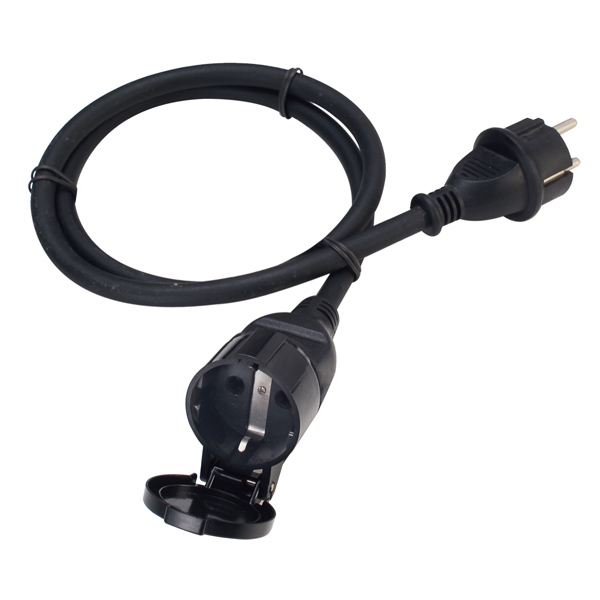
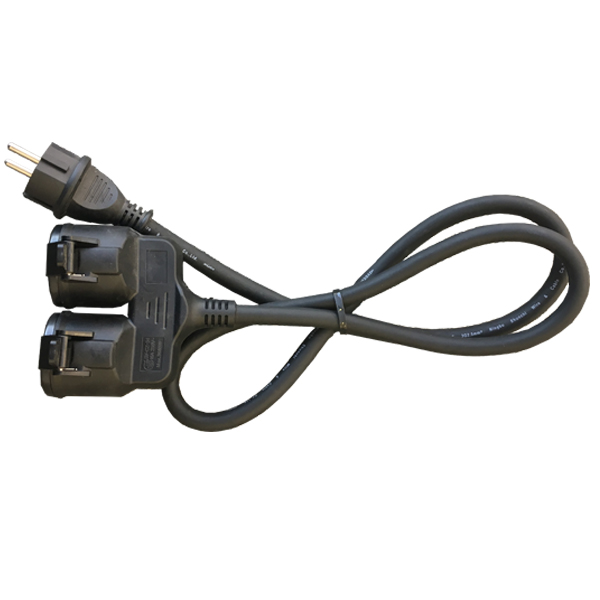
PVC jackets are not oil-resistant by design. Some PVC compounds are rated for light oil contact (such as the occasional drips from a piece of equipment), but a PVC-jacketed cord on a shop floor with daily oil exposure will degrade visibly within months. The two-way outdoor rubber extension cord in the Soyang catalog is an example of an oil-resistant rubber cord designed for both outdoor weather exposure and shop-floor oil contact — the dual rating that PVC cannot match.
UV and Weather Exposure
UV radiation from sunlight degrades both PVC and rubber jacket materials, but at different rates and through different mechanisms. PVC jackets are stabilized with UV inhibitors (typically titanium dioxide or carbon black pigmentation) that absorb the UV and protect the polymer. A UV-stabilized PVC jacket rated for outdoor use (the “W” suffix in SJTW) will typically survive three to five years of continuous outdoor exposure before showing significant surface chalking and brittleness.
Rubber jackets — particularly EPDM and CPE — are inherently more UV-resistant than PVC because the polymer backbone is more chemically stable. A UV-stabilized rubber jacket typically survives five to ten years of continuous outdoor exposure. The jacket color darkens and may chalk slightly, but the mechanical properties (flexibility, tear strength, abrasion resistance) hold up longer than PVC under the same conditions.
Both materials benefit from storage practices that minimize UV exposure. A cord stored on a reel in a covered storage area outlasts a cord stored in direct sunlight on a job-site trailer. The jacket material is one factor in cord life; storage is another.
Abrasion and Cut Resistance
On a rough job site, the jacket is dragged over rebar, sharp edges, broken concrete, gravel, and metal cuttings. The jacket that survives is the one with high abrasion resistance and good cut-through resistance.
Rubber jackets generally have higher abrasion resistance than PVC jackets of the same thickness. The elastomeric nature of the rubber absorbs the impact of an abrasive surface and resists the cutting action of a sharp edge. A rubber-jacketed cord dragged across broken concrete for a year will typically show less jacket wear than a PVC-jacketed cord under the same conditions.
Cut resistance is a different property. A PVC jacket can be cut through with a utility knife in a single pass; a rubber jacket is more difficult to cut, but neither is cut-proof. For environments where the cord is likely to be cut (around sheet metal work, in scrap yards, around heavy equipment with sharp edges), additional protection in the form of a cord cover or a cable protector is recommended regardless of the jacket material. The Copper Development Association (CDA) publishes cable handling and jacket preservation guidance for industrial buyers.
Flame Performance
Both PVC and rubber jackets carry flame-retardant ratings, but the ratings are not equivalent. PVC is inherently flame-retardant because of the chlorine content in the polymer — the material is self-extinguishing and produces relatively low flame spread. Rubber jackets require flame-retardant additives to meet the same rating, and the additive package affects the mechanical properties of the rubber.
For most job-site applications, both materials meet the relevant flame performance standard (VW-1 or FT1 for the cord). The difference shows up in the after-flame time and the smoke generation. PVC produces more dense smoke and corrosive hydrogen chloride gas when it burns; rubber produces less corrosive smoke but more dense carbonaceous smoke. For enclosed-space or below-grade applications, the smoke profile matters; for open-air job-site use, both materials perform comparably. The relevant standard for the flame and smoke profile on a flexible cord is NFPA 70 (NEC) in conjunction with the cord listing standard.
The Seven Job-Site Scenarios That Decide the Choice
Putting the property differences together, seven specific scenarios favor the rubber jacket over PVC. These are not the only scenarios that matter, but they cover the most common failure modes on construction, industrial, and outdoor service sites.
- Cold-weather construction (winter, outdoor, below freezing). Rubber. PVC jacket cracks at the plug end and at bend points; rubber stays flexible to -40 °C or lower.
- Oil and grease contact (auto shops, hydraulic equipment, machine tools). Oil-resistant rubber (CPE or neoprene, the OO designation). PVC swells and degrades.
- Continuous flexing (cord reels, drag chains, robotic tool carriers). Rubber. PVC fatigues at the flex point and cracks after a few thousand cycles; rubber tolerates the same flexing for many more cycles.
- Outdoor storage with full sun exposure. UV-stabilized rubber. PVC jackets chalk and embrittle within three to five years; rubber holds up longer.
- Welding and high-current applications. SOOW or SEOW (rubber or TPE, 600 V). The 600 V rating is required for the high-open-circuit voltage of welding equipment.
- Drag-chain and continuous-motion service. Oil-resistant TPE (SJEOW). Better flex life than PVC at moderate cost.
- Marine and wet environments. Rubber with water-resistance marking. PVC jackets absorb water over time; rubber is more stable.
For each scenario, the rubber cord costs more than the PVC cord. The cost differential is meaningful — typically a 30–80 % premium for the rubber jacket over a PVC jacket of the same AWG and length. The payback is in service life: a rubber cord that survives three winters in the field replaces three PVC cords that each fail in a single winter. Over a three-year horizon, the rubber cord is the better economic choice on any site where the failure mode is in play.
When PVC is the Correct Choice
The PVC jacket is not obsolete. Three categories of application favor PVC on cost grounds.
- Indoor use, mild climate, low mechanical stress. A residential extension cord for occasional indoor use does not need a rubber jacket. PVC is fine.
- Short-duration outdoor use (a season, not a year). A cord used for spring-through-autumn yard work and stored indoors for the winter can be PVC. The jacket sees limited UV exposure and limited cold stress.
- Price-sensitive disposable applications. A contractor who expects to lose or damage the cord regularly may rationally choose PVC for the lower replacement cost.
The Soyang factory background on the Zhejiang Shuangyang Group manufacturing operation covers the full range of extension cord types produced for export markets, including PVC-jacketed cords for indoor and light outdoor use and rubber-jacketed cords for industrial and heavy outdoor service. The factory experience with both jacket types informs the specification guidance above: the right jacket depends on the application, not on a one-size-fits-all preference.
How to Read a Cord Quote
An extension cord quote that does not name the cord designation is a quote that is not specific enough to verify. The five fields that must be on a credible extension cord quote are:
- Cord designation (SJTW, SJOOW, SOOW, SJEOW, SEOW). Defines the jacket material, voltage rating, and resistance properties.
- Conductor gauge (AWG) and conductor count. Defines the ampacity and the appliance class the cord can serve.
- Length in feet or meters. Defines the cord length.
- Plug and connector configuration (NEMA 5-15P, 5-20P, twist-lock, IEC). Defines the connection to the source and the load.
- Certification mark and file number. UL, CSA, or other national mark with the manufacturer’s file number.
A quote that specifies only “extension cord, 100 ft, 14 AWG” without the jacket designation is ambiguous about the actual jacket material and the temperature / oil / weather resistance. Two quotes that both say “100 ft, 14 AWG” can refer to cords at materially different price points if one is SJTW (PVC) and the other is SJOOW (rubber). The jacket designation is the field that determines which cord you are actually buying.
Storage and Handling: Extending Jacket Life
Even the best jacket material is shortened by poor storage and handling. Three practices extend jacket life regardless of the material.
First, store cords on a reel or in a cord bag, not in a tangled pile. Tangled cords are stressed at every bend point in the tangle, accelerating fatigue at the bend. A reel or a bag keeps the cord relaxed.
Second, keep cords out of direct sunlight when not in use. UV exposure is the dominant environmental degradation mechanism for outdoor-stored cords. A covered storage area or a UV-resistant cord bag extends jacket life by years.
Third, inspect the jacket before each use. Look for cracks, soft spots, swelling, or exposed conductor insulation. A jacket with visible damage is a jacket that has lost its protective function; the cord should be retired before it causes a ground fault or shock.
FAQ: Rubber vs PVC Extension Cord Jackets
What is the actual temperature difference between rubber and PVC jackets?
Can a PVC extension cord be used outdoors?
Is the rubber jacket really worth the extra cost?
What is the difference between SJOOW and SOOW?
What does the SJEO designation mean?
How do I know if a cord has been damaged beyond use?
Does UV really damage the jacket that quickly?
Are there certification marks specific to extension cord jackets?
Post time: Sep-17-2026