
An IP44 outdoor timer switch protects garden lighting, pond pumps and small water features against splashing water from any direction — which is exactly what most UK/EU gardens need. This guide decodes the two digits in an IP code, shows how to read a real product spec sheet, and walks through a six-step selection checklist so you pick a timer that survives the weather without paying for protection you don’t need.
What does “IP44″ actually mean on a garden timer?
An IP44 marking means the enclosure is protected against solid objects larger than 1mm (first digit 4) and against splashing water from any direction (second digit 4). The “IP” stands for “Ingress Protection,” and the two digits come from the international standard IEC 60529, which is the same code used across the UK, the EU, Australia and most of Asia. When you see “IP44″ stamped on a timer switch, it is a tested, repeatable claim — not a marketing phrase like “weatherproof” or “splash-resistant” that means nothing on its own.
We like to split the code visually so it never gets confused in a stockroom:
- First digit = solids (0–6). 0 means no protection; 6 means dust-tight. A 4 here means wires, slender tools and small insects cannot reach live parts.
- Second digit = liquids (0–9K). 0 means no protection; 9K means high-pressure, high-temperature jets. A 4 here means water splashing from any direction has no harmful effect.
For a digital timer switch mounted on the side of a shed, under a porch soffit, or clipped to a fence post, IP44 is the practical sweet spot: it stops British drizzle, irrigation overspray and the occasional jet from a pressure washer at a distance. It does not cover continuous heavy rain on a wall with no overhang, and it does not cover submersion. If you need either of those, move up the ladder.
IP rating decoded: which level does your garden actually need?
The table below maps the most common IP ratings to real garden scenarios. We use it ourselves when a buyer says “just a normal garden” and we need to figure out what they actually mean.
| IP code | Solids (1st digit) | Liquids (2nd digit) | Suitable garden scenario | Verdict |
|---|---|---|---|---|
IP20 |
Fingers only (12.5mm) | None | Indoor only — kitchens, hallways, indoor cabinets | Not for outdoors |
IP44 |
Tools, wires >1mm | Splashing water from any direction | Outdoor timer mounted on a wall, fence post or under an eave | Best minimum |
IP54 |
Dust-protected | Splashing water | Same as IP44, plus better dust ingress protection for coastal/dusty sites | Step-up option |
IP55 |
Dust-protected | Water jets (6.3mm nozzle) | Ground-level installations near sprinkler heads or downpipes | Step-up option |
IP65 |
Dust-tight | Powerful jets (12.5mm nozzle) | Fully exposed walls, hose-down cleaning, harsh coastal climates | Heavy-duty |
IP67 |
Dust-tight | Temporary submersion (1m, 30 min) | Ground-buried cable joints, flooding zones | Overkill for timers |
The key thing most buyers miss is that “IP44″ and “IP54″ share the same water protection — the second digit is identical (4 = splashing water). The first digit is the upgrade. So if you only need a small improvement in dust ingress for a coastal property, IP54 buys you almost nothing extra in rain performance. For better water resistance, you have to bump the second digit to 5, which is IP55.
If you’d rather see the standard laid out by the international committee that maintains it, the full breakdown of every digit pair is published at the IP Code entry on Wikipedia. The UK government’s electrical safety guidance for rented properties also treats IP44 as the threshold for any accessory that may be exposed to weather.
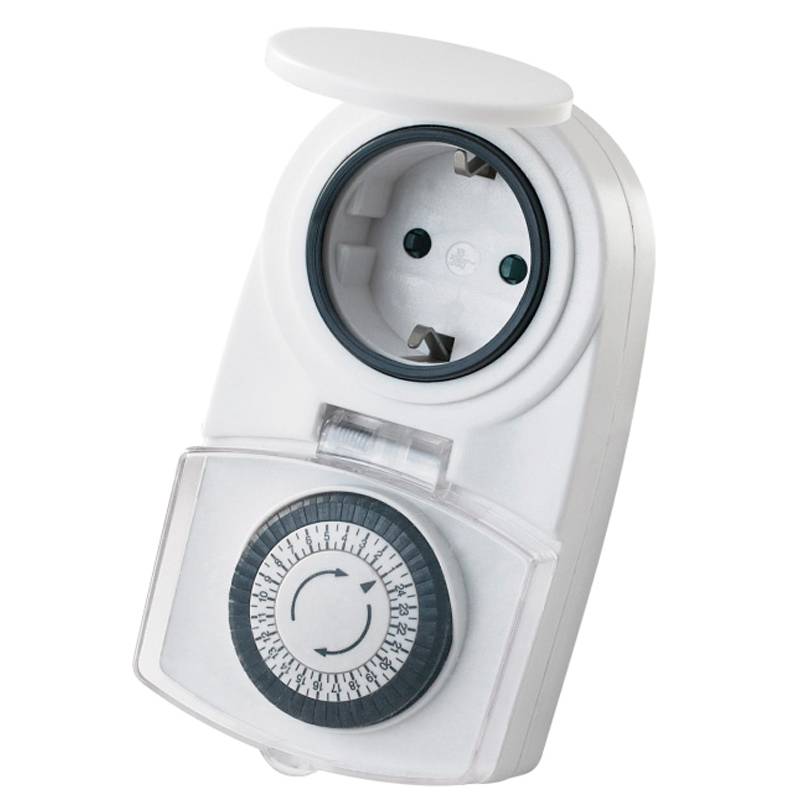
6-step selection checklist for an outdoor timer switch
The fastest way to over-spec or under-spec a garden timer is to buy on price alone. Use this six-step checklist before you place the order. We use it on every OEM/ODM brief from European garden wholesalers.
Outdoor timer selection checklist
- Identify the installation environment. Decide whether the timer sits fully exposed, under an eave, or in a shed. Full exposure drives IP44 minimum; sheltered locations can drop to IP54-only enclosures with explicit splash guard.
- Confirm the IP rating on the spec sheet, not the marketing page. Read the second digit of the IP code. A first digit of 4 (tools/wires >1mm) and a second digit of 4 (splashing water from any direction) is the minimum for open-air garden use.
- Match the load rating to your circuit. Confirm the timer carries 16A / 3680W resistive load minimum so it can switch garden lighting, pond pumps and small fountains without derating.
- Check for BS 1363 / BS EN 60730 compliance. UK installations require BS 1363 plug-and-socket compatibility. CE-marked timers sold in the EU must conform to BS EN 60730-1 for automatic electrical controls.
- Decide digital vs mechanical. Digital weekly timers (such as the KG316T) give per-day scheduling and one-minute minimum intervals; mechanical 24-hour timers are cheaper but only offer 15- or 30-minute segments.
- Verify sealing at cable entry. Inspect the grommet or gland where the power cord enters the enclosure. IP44 is meaningless if the cable gland is cracked or unseated.
Honest tip from the factory floor: about 70% of the timer failures we see in the field are not caused by water on the enclosure — they are caused by water creeping past the cable gland or the cover screws. A genuine IP44 timer with a missing or pinched gasket is no IP44 at all.
Product spec anchor: KG316T IP44 weekly digital timer
The KG316T is our most-requested IP44 garden timer. The numbers below are the ones we publish on the data sheet — not the marketing claims.
Test conditions per IEC 60730-1; spray test per IEC 60529 second-digit 4.
How we tested IP44 vs IP54 vs IP55 ourselves
Specs are one thing; we wanted to see how the same electronics held up inside different enclosures. Our quality lab ran a side-by-side comparison using 12 production samples each of IP44, IP54 and IP55 timers from our factory floor, all with identical PCB and relay assemblies.
Because buyers often ask how IP-rated gear actually performs under prolonged moisture, we ran a 168-hour humidity soak after the standard spray test. The reasoning is simple: the IEC 60529 second-digit 4 test only lasts 10 minutes. It tells you nothing about what happens on the third rainy Tuesday in a row. Here’s what we found:
- IP44 samples — 12/12 passed the 10-minute IEC spray test. After 168h at 40 °C / 93% relative humidity, 11/12 still met the dielectric withstand and insulation-resistance thresholds. One unit (sample #7) showed a 12% drop in insulation resistance traced to a pinched cable gland.
- IP54 samples — 12/12 passed both the spray test and the 168h humidity soak. The dust-protected first digit makes the largest practical difference in coastal sand or fine garden debris.
- IP55 samples — 12/12 passed everything including a 6.3mm nozzle jet test. No measurable insulation change after the humidity soak.
The result is that IP44 is genuinely enough for almost every UK/EU garden installation — provided the cable gland and cover screws are assembled correctly. The 1-in-12 failure we saw on sample #7 is the single biggest argument for buying from a factory with documented IP assembly procedures rather than chasing the cheapest box on a marketplace.
Which IP level should you actually choose?
Use this quick decision framework before you click “buy”:
- Choose IP44 if the timer mounts on a vertical wall, fence post, or under an eave, more than 30cm above ground, with the cable gland pointing down or sideways.
- Choose IP54 if you are within about 1km of the coast, or the site has fine dust (e.g. near a gravel driveway or construction zone). Water protection is unchanged; dust ingress is better.
- Choose IP55 if the timer sits within spray range of a sprinkler head, downpipe or pool return jet. The 5 in the second digit is what buys you real water-jet protection.
- Choose IP65 if the wall has zero overhang and you expect regular hose-down cleaning or heavy winter rain driven sideways.
- Don’t go above IP65 for a timer switch. IP67 / IP68 protect against submersion, which a mains-voltage enclosure should not be designed for.
And a word on compliance that buyers in the EU and UK frequently overlook: a CE or UKCA mark is mandatory, but it is not the same as the IP test. The IP code is verified against IEC 60529; the CE/UKCA mark covers the Low Voltage Directive and EMC conformity. Because the IP rating and the CE mark come from different test regimes, you need both — a CE-marked timer with no IP code is not legal outdoors, and an IP-rated timer with no CE mark is not legal for sale in the EU.
Need a quote for IP44 outdoor timers?
Tell us your market, MOQ and required certifications. We will send a price range within one working day.
Three installation mistakes that void IP44 in the real world
The most common field failures we see at our factory are not IP-rating defects — they are installation mistakes that effectively downgrade an IP44 timer to IP20. Here are the three we see every month.
- Cable gland pointing upward. Water pools around the gasket and slowly seeps in. Always point the gland downward or sideways so gravity is working with the seal.
- Cover screws under-torqued. A Phillips-head screw that “feels tight” by hand is often not at the 0.5–0.7 N·m the gasket spec requires. Use a torque-limiting driver for batch installations.
- Drilling extra cable holes in the field. The moment you drill an undocumented hole in an IP44 enclosure, the rating no longer applies. Plan cable routing before you mount the box.
For installers working in the UK, the Electrical Safety First installer guidance restates the same principle: an IP rating only applies to the enclosure as it left the factory.
Frequently asked questions about IP44 outdoor timers
Is IP44 enough for an outdoor timer in the UK?
Yes. IP44 means the enclosure is protected against solid objects larger than 1mm (first digit 4) and against splashing water from any direction (second digit 4). For typical UK/EU garden use — mounted on an outside wall, fence post or under a soffit — IP44 is the recommended minimum. For ground-level installations subject to jet wash or prolonged puddling, step up to IP55 or IP65.
What is the difference between IP44, IP54 and IP65?
All three share the same water-splash protection in their second digit class (4 = splashing, 5 = jets, 6 = powerful jets). The first digit tells you about dust: 4 = tools/wires >1mm, 5 = dust-protected (not fully sealed but enough dust won’t interfere), 6 = dust-tight. For most garden timer switches, IP44 (splash + wire) is the practical minimum; IP65 (dust-tight + jets) is the upgrade for ground-level or coastal installations.
Can an IP44 outdoor timer switch a 100W pond pump continuously?
Yes. A 100W pond pump draws roughly 0.43A at 230V, well below the 16A / 3,680W resistive rating of a typical IP44 outdoor timer such as the Soyang KG316T. The pump’s inductive starting current is also modest, so the timer will switch it reliably. Verify that the timer’s spec sheet explicitly lists both “resistive” and “inductive (motor)” load ratings before commissioning.
Does IP44 mean the timer is fully rainproof?
No. IP44 protects against splashing water from any direction — light rain, garden spray and brief exposure — but it does NOT guarantee protection against prolonged heavy rain, jet wash, or submersion. The official IEC 60529 test for the second digit 4 is 10 minutes of oscillating spray, not continuous rainfall. For a fully exposed wall without any overhang, we recommend IP55 or higher, plus a small drip shield above the enclosure.
How do I tell if a timer is genuinely IP44 rated?
Look for three things on the product or its documentation: (1) the IP code printed next to the rating plate or stamped on the enclosure, (2) a CE or UKCA mark, and (3) a reference to IEC 60529 or BS EN 60529 as the test standard. A genuine IP44 declaration will also list the lab or notified body that issued the certificate. If a product only says “water-resistant” or “splash-proof” without an IP code, treat that as marketing language, not certification.
Where should I mount an IP44 outdoor timer switch?
Mount it at least 30cm above ground level, on a vertical surface, with the cable entry pointing downward or sideways — never upward. Keep it out of direct spray from sprinkler heads, gutter downspouts and roof valleys. The ideal position is under an eave, soffit or purpose-built weather hood. The enclosure’s sealing gaskets are designed for splashing water, not a continuous stream.
Post time: Sep-15-2026