
- Confirm the equipment load and switching method before comparing timer features.
- Use digital control for complex schedules and mechanical control for simple repeat cycles.
- Match enclosure protection and cable connections to dust, moisture, impact, and temperature exposure.
- Separate timer selection from safety isolation, overload protection, and emergency-stop design.
- Request test reports, drawings, samples, and compliance documents for industrial procurement.
Choosing an industrial timer switch requires more than comparing a time dial or display. The correct machine control timer must coordinate electrical load behavior, operating schedule, environmental exposure, installation method, and risk controls. The IEC 60529 standard defines the IP code using two characteristic numerals, so enclosure selection should be treated as a documented protection decision rather than a marketing label. This guide explains how to evaluate the complete control chain.
What an Industrial Timer Switch Does in Machine Control
An industrial timer switch controls when an electrical circuit is energized, de-energized, or allowed to operate according to a programmed schedule. It can be used for lighting, ventilation, pumps, heaters, chargers, signage, irrigation equipment, and auxiliary machine functions.
The timer is not normally a substitute for a contactor, overload relay, circuit breaker, emergency stop, or machine safety controller. Its primary job is time-based control. Protection against short circuits, overloads, unexpected restart, and hazardous motion must be designed separately according to the equipment risk assessment.
A practical example is a workshop ventilation fan that must run during defined production periods. The timer can initiate the schedule, while a correctly rated switching device, protective device, and isolation arrangement handle the electrical and safety requirements. For a high-inrush motor, the timer may need to control a contactor instead of switching the motor directly.
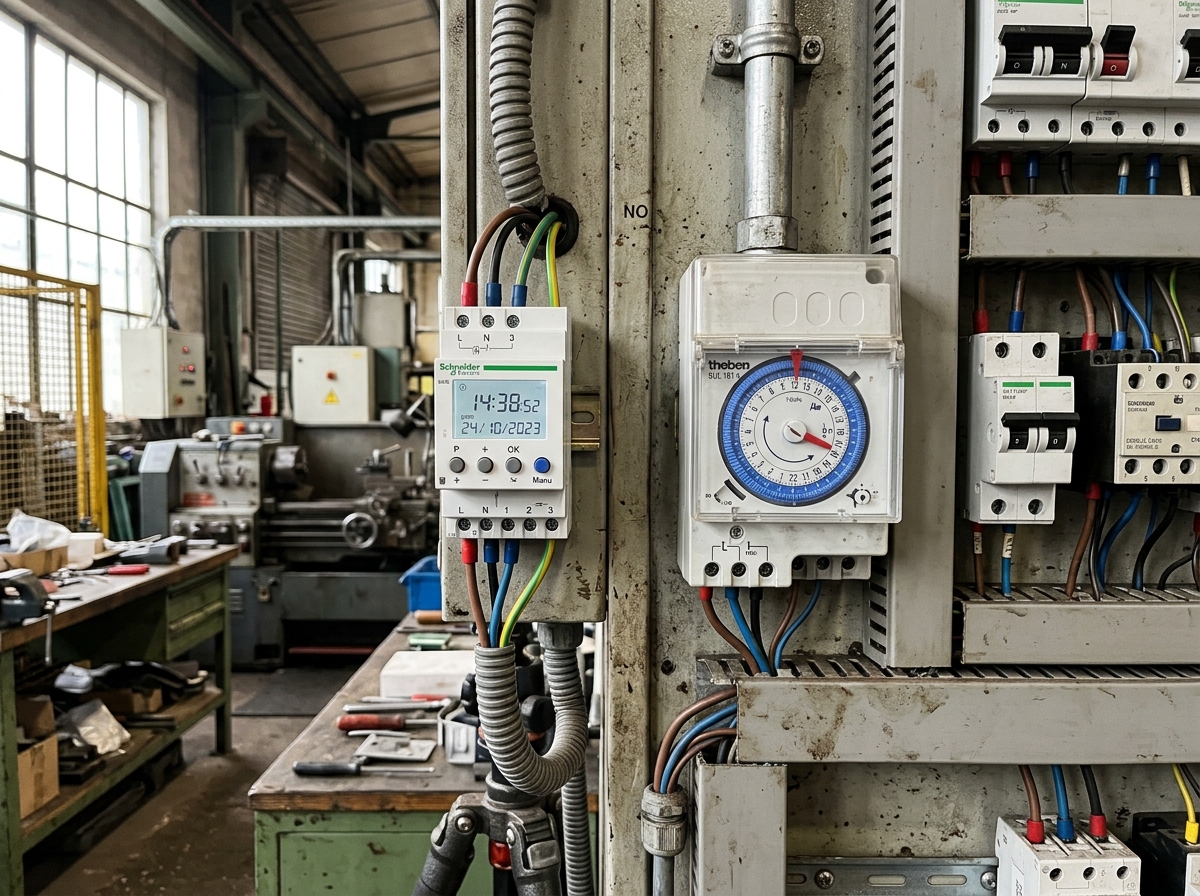 Industrial Timer Switch Selection Criteria
1. Identify the load before choosing the timer
Load classification is the first selection decision because resistive, inductive, capacitive, and electronic loads stress contacts differently. A heater usually presents a mainly resistive load, while a motor can create starting current and electrical arcing when switched. LED drivers, transformers, compressors, and power supplies may also produce inrush that is not obvious from their running wattage.
Read the equipment nameplate and technical documentation, then check voltage, running current, starting behavior, power factor, switching frequency, and whether the load must be switched on one pole or more than one pole. If the timer output is not suitable for the actual load, use the timer to operate an appropriately rated relay or contactor.
| Load type | Typical control concern | Preferred evaluation point | Direct timer suitability |
|---|---|---|---|
| Heater | Continuous thermal load | Rated current, terminal temperature, duty cycle | Possible when the rating matches the installation |
| Fan or pump motor | Starting current and inductive switching | Motor data, contact rating, contactor requirement | Often requires an interface device |
| LED driver | Electronic inrush and power factor | Driver data and switching compatibility | Verify manufacturer limits |
| Battery charger | Electronic input behavior and continuous operation | Input current, charging schedule, ventilation | Verify the complete charger circuit |
2. Choose digital or mechanical control
Digital timer switches provide flexible programming, readable settings, and repeatable schedules when the application changes frequently. They are useful for weekday and weekend routines, multiple on-off events, seasonal operation, or installations where a precise schedule must be recorded.
Mechanical timer switches are often easier to understand at a glance and can be appropriate for simple repeating control. Their appeal is straightforward adjustment and low operating complexity. They are less suitable when the schedule requires several exceptions, frequent changes, or detailed documentation.
| Control characteristic | Mechanical timer | Digital timer | Selection question |
|---|---|---|---|
| Programming approach | Physical dial or segments | Electronic menu or keypad | How complex is the schedule? |
| Schedule visibility | Immediate visual indication | Display-based review | Will operators inspect it during a shift? |
| Change management | Fast for basic changes | Better for multiple exceptions | How often will settings change? |
| Backup behavior | Depends on mechanism and power state | May include memory support | What happens after power interruption? |
The best choice is the simplest control that reliably meets the schedule. Avoid selecting a digital model merely because it has more functions; unnecessary programming complexity can create operator errors and maintenance delays.
How to Match the Timer to the Installation Environment
Environmental compatibility is as important as electrical rating because moisture, dust, impact, ultraviolet exposure, and temperature can shorten service life or create unsafe conditions. A timer installed inside a clean electrical cabinet has different requirements from one used on a temporary construction site.
Use the IP classification as one part of the enclosure assessment. The first IP characteristic numeral addresses protection against solid objects and dust, while the second addresses water ingress. The IEC 60529 publication is the authoritative reference for interpreting the code; the product datasheet should state the tested or declared rating and the conditions under which it applies.
For outdoor or mobile use, also examine cable flexibility, strain relief, UV exposure, impact resistance, connector sealing, and storage conditions. An enclosure rating alone does not prove that a complete timer, plug, socket, cable, and installation assembly is suitable for every outdoor environment.
- For clean indoor areas, prioritize clear operation, accessible terminals, and simple maintenance.
- For workshops, evaluate dust, vibration, impact, cable routing, and accidental adjustment.
- For outdoor locations, review moisture, sunlight, temperature changes, drainage, and connector protection.
- For construction sites, consider portability, mechanical abuse, repeated plugging, and temporary power distribution.
Timing Accuracy, Power Loss, and Machine Behavior
Timing performance should be defined by the application rather than by a vague promise of precision. Ask whether the process needs an approximate daily start, a repeatable interval, or synchronization with another controller. A ventilation schedule may tolerate ordinary clock drift, while dosing, production sequencing, or coordinated automation may require a different control architecture.
Power interruption behavior is a critical specification for a machine control timer. Confirm whether the timer retains its program, resets to a defined state, restarts automatically, or requires manual intervention. The acceptable behavior depends on the load: automatic restart may be convenient for a fan but undesirable for equipment that can create a hazard when motion resumes.
The physical definition of the SI second is based on 9,192,631,770 periods of a specified cesium transition, according to the National Institute of Standards and Technology. That scientific definition does not mean every commercial timer has laboratory timing performance. Buyers should therefore request the manufacturer’s stated timing tolerance, operating conditions, and backup specifications instead of inferring accuracy from the word digital.
Electrical Safety and Compliance Checks
Compliance review should cover the complete intended use, not only the timer enclosure. Verify the product’s rated voltage, current, frequency, terminal configuration, switching category, insulation information, temperature limits, installation instructions, and applicable market documentation.
For United States installations, the OSHA electrical standards require electrical equipment to be suitable for the installation and use conditions. This supports a practical procurement rule: do not approve a timer from a label alone. Review the product documentation and confirm that the complete installation meets the requirements of the destination market and application.
Important safety questions include whether the timer can be manually overridden, whether the circuit remains energized during maintenance, and whether an unexpected restart is possible after power recovery. A timer should not defeat an emergency-stop circuit or a required guard interlock.
Procurement Checklist for an Electrical Timer Switch
A structured purchase request reduces unsuitable samples and shortens technical clarification cycles. Include the following information when contacting a manufacturer or distributor:
- Equipment type, supply voltage, frequency, running current, and starting characteristics.
- Required schedule, switching interval, number of events, and seasonal or weekday variation.
- Indoor, industrial, outdoor, temporary, or mobile installation environment.
- Enclosure, connector, cable, mounting, and operating-temperature requirements.
- Required manual override, power-failure behavior, and restart policy.
- Destination market, documentation needs, packaging requirements, and expected volume.
- Sample approval, inspection plan, test reports, drawings, and change-control expectations.
For OEM and private-label projects, ask for a controlled specification sheet before discussing artwork or packaging. The specification should identify the electrical configuration, materials, markings, testing scope, production version, and acceptance criteria. This creates a traceable baseline for samples and repeat orders.
Common Selection Mistakes
The most common mistake is sizing a timer from the appliance wattage without checking inrush or inductive switching. This can lead to contact wear, welding, nuisance failure, or unsafe downtime.
Another mistake is treating a high IP code as proof of complete outdoor suitability. Cable entries, plugs, sockets, mounting orientation, condensation, and cleaning methods can change the real installation performance.
A third mistake is ignoring human factors. A timer that technically supports the schedule may still be unsuitable if operators cannot read the settings, identify the override state, or restore the program after a power interruption.
The final mistake is specifying compliance documents too late. Request destination-market documentation, drawings, samples, and test evidence during the quotation stage so that technical and commercial decisions are aligned.
FAQ
What is an industrial timer switch?
An industrial timer switch is a time-based electrical control device used to start, stop, or schedule a circuit. It may switch a load directly when appropriately rated or control a relay or contactor in a larger machine circuit.
Should I choose a digital or mechanical timer?
Choose digital control for complex schedules, frequent changes, multiple events, or stronger program visibility. Choose mechanical control for simple repeating schedules where direct adjustment and low complexity are more valuable.
Can a timer switch control a motor?
It can control a motor only when the timer output and switching category are suitable for the motor circuit. Many motor applications should use the timer to control a properly rated contactor rather than switching the motor directly.
Does an IP rating make a timer suitable for outdoor use?
No. An IP rating addresses defined ingress protection, but outdoor suitability also depends on temperature, ultraviolet exposure, impact, cable entry, condensation, mounting, and the complete connected assembly.
What happens when power fails?
Behavior varies by model. A timer may retain its program, lose the current time, remain off, or restart according to its design. Confirm the backup and restart behavior before using it on equipment that could create a hazard after automatic recovery.
What information should I send for a timer quotation?
Provide the load type, voltage, frequency, current, schedule, environment, connector or mounting requirements, destination market, packaging needs, expected quantity, and required documents. Photos and nameplate data can improve the first technical review.
Can an industrial timer switch replace a safety controller?
No. A timer provides time-based control and should not replace emergency-stop functions, guard interlocks, overload protection, isolation, or a dedicated safety controller where those functions are required.
About the Manufacturer
The manufacturer behind this product range focuses on electrical connection and control products, including digital and mechanical timers, industrial plugs and sockets, extension cords, cable reels, and cable-management accessories. Its capabilities include product development, testing, automated production, export support, and OEM or ODM cooperation. Buyers can review the company website for product information and contact options when requesting samples, technical documents, or a tailored quotation.

Post time: Oct-12-2026