
TL;DR
- A custom cable reel programme is decided by three choices made before the drawing exists: the cable length and conductor, the market version, and the packing plan. Each one sets the drum, the approval set and the freight arithmetic, and each one is expensive to change afterwards.
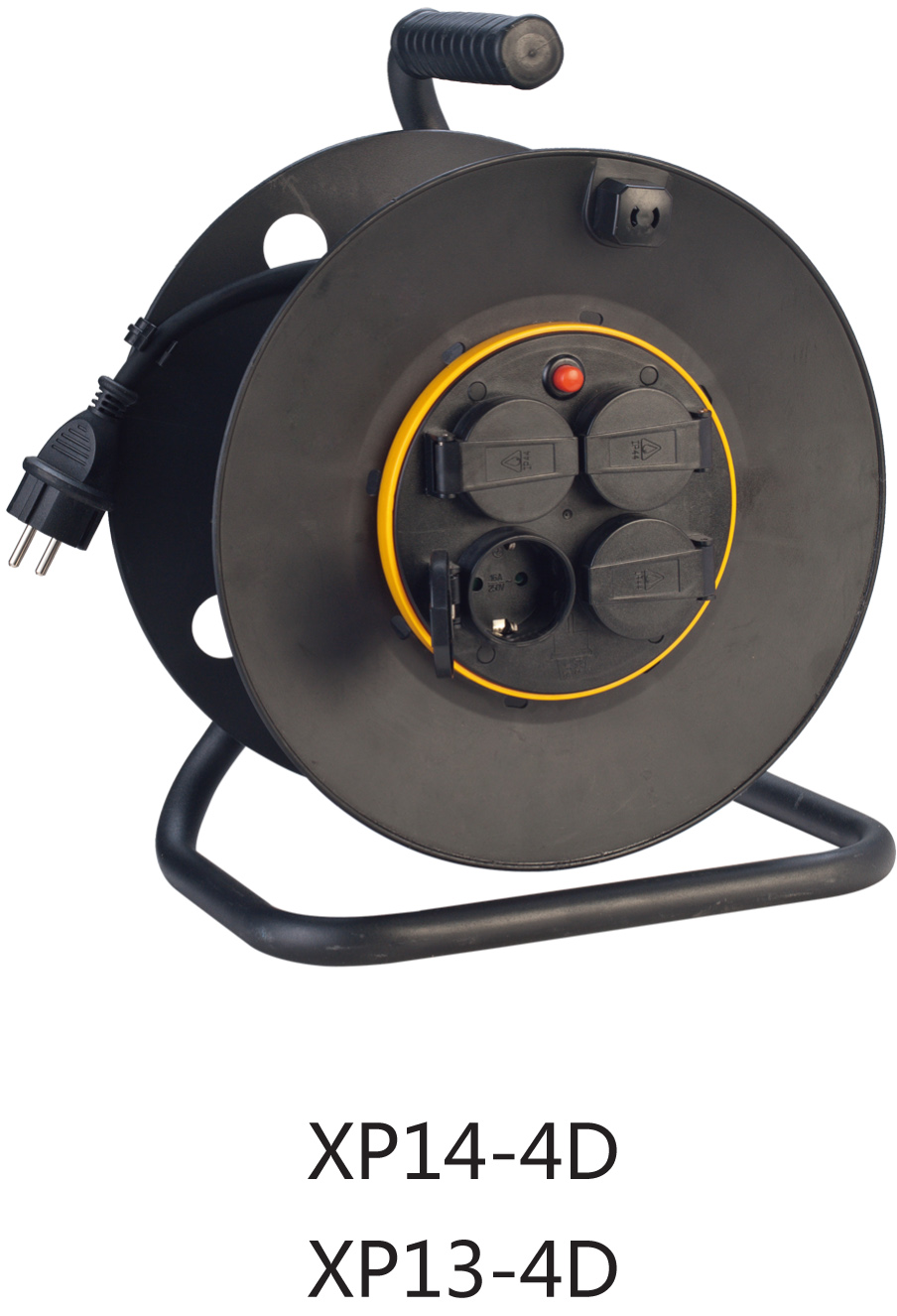
- The published XP13-D European reel shows what the drawing has to lock: IP44, 230 V AC 50 Hz, a 235 mm outer diameter, black housing, stranded copper with rubber insulation, and a length set by the customer, with German, French and Danish versions available.
- Mass production runs on four stages, and they are documented rather than claimed: injection moulding of PP panels and iron frame handles, plug wire processing with German-style cores, cable reel assembly with automatic winding, and packaging into storage with palletising and a final carton verification.
- Quality is held by three inspection gates that run alongside production, and the lead-time numbers live on different pages: 25 days after the deposit for production, and an estimated 60 days for delivery of 1 to 10,000 pieces.
Most custom cable reel enquiries arrive as a request for a quote against a drawing, and most of them fail later, not because the factory is slow but because the specification was not settled before the tool was cut. The cable reel is a small electrical product with an unusually large number of coupled decisions, and each of them is coupled to the approval set and to the carton. On the published XP13-D, a 3G1.0 mm² H05RR-F cable over 40 metres supports 900 W wound and 2300 W unwound, while 3G1.5 mm² over 25 metres supports 1000 W and 3000 W, so a small change in cable length and gauge moves the drum, the power rating and the test file at the same time.
The three decisions that come before the drawing
Getting these three right is what separates a programme that runs from one that stalls.
One: the cable length and the conductor. The length is not a packing option, it is a product decision. The XP13-D is published with customer-specified lengths such as 10 m, 25 m and 50 m, and the conductor choice decides the derating: H05RR-F 3G1.0 or H05RN-F 3G1.0 for up to 40 metres at 900 W wound and 2300 W unwound, and H05RR-F 3G1.5 or H07RN-F 3G1.5 for up to 25 metres at 1000 W wound and 3000 W unwound. Because the conductor and the length are quoted together in the rating table, changing one without the other produces a reel whose label no longer matches its test file.
Two: the market version. The published reel is a German version, and the product range carries France and Denmark versions as well. A version is not only a plug, it is a certification set, an artwork set and a carton set, so switching version mid-programme means new approvals, new packaging and a new first article, not a plug swap on the assembly line.
Three: the packing plan. The reel ships as one piece per colour box and two boxes per outer carton, with a carton of 42 x 27 x 34 cm. Because the carton is fixed before the first pallet is built, the packing decision is really a freight decision, and it is the one that buyers most often leave to the factory.
Stage one: what the drawing has to lock
A cable reel drawing is an identity document, because everything downstream keys off it.
The published quick details for the XP13-D are exactly what a custom drawing has to resolve: brand name, model number, type as insulated, application as overhead conductor, conductor material as copper, conductor type as stranded, insulation material as rubber, colour, outer diameter of 235 mm, heat security, and a length and packing set to the customer’s requirement.
Two of those lines are worth reading twice in a buying meeting. The outer diameter fixes the panel geometry and therefore the moulding, and the heat security line is the one that decides whether the reel passes the target market’s temperature tests. Because a drawing revision after the panels are moulded is a scrap risk rather than a paperwork exercise, the drawing should be issued as a controlled document with a revision number, not as a marked-up PDF.
The socket panel is where the drawing stops being a shape and becomes a compliance object. The published assembly sequence fits a waterproof cover, spring and shaft to the front of the German-style panel, and on the back a grounding assembly, safety pieces, a temperature control switch, a waterproof cap and a conductive assembly, each of which is a drawing line with a test behind it. Because the socket count and the panel variant travel with the version, the drawing has to carry both.
Stage two: the certification map
The reel and the approvals travel together, and the map is wider than most buyers expect.
The European cable reel is published with CE, GS and VDE certification, and the certificate list on the same product page also names NF, S, RoHS, REACH and PAHS, with the Germany version specified as the plug and panel arrangement and 230 V AC at 50 Hz. Underneath the product sits a group approval set that covers CE, GS, D, N, S, NF, ETL and VDE, and the management system is certified to ISO 9001, ISO 14000 and ISO 18000.
It is worth noticing that the same OEM capability covers a different product class with a different approval set: the digital weekly timer switch in the same catalogue is a TS-ED20 Germany version, rated 3500 W at 220-240 V AC 50 Hz and 16 A, with 20 on and off programmes and timekeeping accuracy of less than 3 seconds per day, certified to GS, CE, RoHS, REACH and PAHS. Because a supplier that certifies a mechanical reel and an electronic timer is running the same drawing, planning and inspection discipline across both, that is the argument to make when you want a second category added to the programme later.
It helps to separate the framework from the mark. The Low Voltage Directive 2014/35/EU and the CE marking framework are what make the CE mark meaningful, because the mark follows a declaration of conformity and a technical file rather than a supplier’s preference. The Low Voltage Directive 2014/35/EU sets the essential health and safety requirements, the RoHS Directive 2011/65/EU restricts hazardous substances in the plastic and metal parts, and REACH adds the substance obligations behind the entries in the certificate list. Because the reel is sold with a printed claim of compliance on its nameplate and its box, the buyer should ask which document each entry comes from, because a certificate list is otherwise just a list. The management system behind the approvals is ISO 9001, with ISO 14000 and ISO 18000 alongside it.
Stage three: the carton plan
Freight is decided on the pallet, and the pallet is decided by the carton.
For the cable reel the published packing is one piece per colour box, two boxes per outer carton, and a carton size of 42 x 27 x 34 cm. The timer in the same group shows the other end of the same discipline: a double blister pack with 12 pieces per box and 48 per carton, gross weight 10 kg and net 8 kg, a carton of 55 x 53 x 28 cm, and 16,464 pieces per 20-foot container.
Because carton quantity and carton dimensions decide both the container fill and the handling damage rate, the packing plan belongs in the specification with the drawing, not with the logistics team after production. A colour box that is too generous raises the freight rate per reel and the volume of protective material a buyer then has to dispose of in the destination market.
Stage four: from the order to mass production
The commercial flow and the shop floor flow are both documented, and a buyer should ask to see both.
On the sales side, an order goes to the planning department for price review, the order handler enters the quantity, price, packaging method and delivery date into the ERP system, and the order is then reviewed by production, supply and sales before the system releases it. The production planner builds the main production plan and the material requirements plan, procurement supplies iron reels, iron frames, copper parts, plastic and packaging materials, and the workshop schedules the line.
On the shop floor, the XP15-D sequence is injection moulding of PP material into reel panels and iron frame handles, then plug wire processing, then cable reel assembly, then packaging into storage. Plug wire processing is three steps: wire stripping to expose the copper, riveting of German-style plug cores onto the stripped conductors, and injection moulding of the plugs around those crimped cores. Assembly is reel installation, iron frame installation, panel assembly at the front and back, panel installation with sealing strips and the power cord plug secured by cable clamps, and then automatic cable winding onto the drum. Packaging is labelling, bagging, instructions, boxing and palletising.
Quality is held by three gates that run at the same time as production rather than at the end of it: an initial piece inspection of the first reel of every batch for appearance and performance, in-process checks such as wire stripping length against the process requirement, and a final inspection of the reel before it is bagged and boxed. A final verification confirms that the model, quantity, labels and carton markings meet requirements before the goods enter storage.
The capacity behind that sequence is published as well: a production base of 120,000 square metres of factory area and 85,000 square metres of construction area, more than 100 quality staff and ten R&D engineers, and group turnover of 90 million US dollars in 2025, with the group located in Cixi, Ningbo, an hour from Ningbo harbour and airport and two hours from Shanghai.
Where custom cable reel programmes go wrong
The failures are predictable, and all of them are sequencing errors.
The most expensive one is changing the market version after approval, because the plug, the panel, the artwork and the certificate set all move together. The second is changing the conductor or the length while keeping the model number, which leaves a label that no longer matches the test file. The third is discovering the carton after the first pallet is built, because carton rework is slow and the delay lands on the delivery date rather than on the cost.
There is also a lead-time trap worth naming, because our own pages publish two different numbers for two different things: 25 days after receipt of the deposit for production, and an estimated 60 days for delivery of quantities between 1 and 10,000 pieces, with larger volumes negotiated. Because the two figures describe different clocks, a buyer who treats the shorter one as a delivery promise will plan a launch date around a number that was never a delivery commitment.
What to fix before you contact the factory
Six items, and all of them are decisions rather than questions.
- Fix the cable length and conductor, and ask for the derating table that goes with that combination.
- Fix the market version, then ask which approvals that version carries and which it does not.
- Fix the packing plan, including the colour box, the outer carton and the carton dimensions.
- Ask for the drawing as a controlled document with a revision number before any tooling is cut.
- Ask which inspection gates run in-process and what is recorded at each of them.
- Ask for the lead time broken into production and delivery, and for the condition that changes it.
Our OEM and ODM service covers this sequence rather than only the quotation, and the timer and extension cord programmes run through the same planning, ERP and inspection structure as the cable reel. The services page sets out the wider capability, and the XP15-D production and sales process page shows the order flow and the line steps in detail, which is the quickest way for a buyer to judge whether a supplier is describing a real process or a marketing summary.
Frequently asked questions
What has to be decided before a custom cable reel drawing is issued?
Three coupled choices: the cable length and conductor, the market version, and the packing plan. The length and conductor set the drum and the power rating, with the published XP13-D supporting 900 W wound and 2300 W unwound on 3G1.0 over 40 metres and 1000 W and 3000 W on 3G1.5 over 25 metres. The version sets the approvals and artwork, and the packing plan sets the carton and the freight.
How long does a custom cable reel programme take?
The published figures are 25 days after receipt of the deposit for production, and an estimated 60 days for delivery of 1 to 10,000 pieces, with larger quantities negotiated. They describe different clocks, so the delivery estimate is the number to plan a launch date against, and the condition that changes it is normally the approval file rather than the production floor.
Which approvals does a European cable reel need?
The published XP13-D carries CE, GS and VDE, with the certificate list on the same page also naming NF, S, RoHS, REACH and PAHS for the Germany version. Underneath the product, the group approval set covers CE, GS, D, N, S, NF, ETL and VDE, and the management system runs on ISO 9001, ISO 14000 and ISO 18000.
How is quality controlled during mass production?
Three gates run alongside production rather than at the end of it: an initial piece inspection of the first reel of every batch, in-process checks against the process requirements such as wire stripping length, and a final inspection before packaging. A final verification confirms model, quantity, labels and carton markings before the goods are stored.
Can one OEM supplier run both a cable reel and a timer programme?
Yes, and the published ranges show the same structure applied to both. The digital weekly timer switch is a TS-ED20 Germany version at 3500 W, 220-240 V AC 50 Hz and 16 A, with 20 programmes, a rechargeable Ni-MH battery and accuracy of less than 3 seconds per day, certified to GS, CE, RoHS, REACH and PAHS, with OEM and ODM service provided.
Published by the OEM and ODM team, Zhejiang Shuangyang Group Co., Ltd.
Ningbo, China, established 1986. A manufacturer of cable reels, extension cords, sockets and plugs, and timers, supplying European and American markets with custom and private-label programmes. This article was written from the company’s own product and process documentation.
Post time: Nov-12-2026