

Quick read
Most procurement failures on a construction-site cable reel are not cable failures — they are specification failures. A cable reel that looked fine on a PDF datasheet arrives on the jobsite, gets a single hard impact against the steel scaffold, and trips a thermal cutout for reasons that have nothing to do with the cable and everything to do with the reel frame. This cable reel buying guide for construction sites walks through the full specification stack — cable conductor / insulation / jacket, reel drum / frame / guide / retraction, IP44 / IP54 / IP65 ingress protection, CE / GS / RoHS compliance, IEC 61242 / EN 61316 functional safety, and total cost of ownership — so that a distributor or contractor buying cable reels for a 2026 EU or Middle-Eastern construction project is the one who can defend each line item in the spec sheet, not the one who has to apologize for it on site.
Why Cable Reel Choice Is a Specification Decision, Not a Cable Decision
The instinct, when buying a cable reel, is to start with the cable — wire gauge, conductor material, jacket. The instinct is wrong on a construction site. The cable is the most standardized sub-component in the assembly: H07RN-F, H05VV-F, and their regional equivalents are mature commodity products with published specifications from every cable maker in Europe, China, and Southeast Asia. The reel — the drum, the frame, the guide, the retraction mechanism, the IP-rated socket enclosure, the thermal cutout, the RCD — is where every cable-reel maker differentiates itself, and is also where most of the safety, ergonomic, and lifetime-cost variance lives.
This matters because a construction-site cable reel spends more of its life wound or partly-wound on the drum than it does unwound in active use. The cable is bent once per deployment. The drum is bent tens of thousands of times. The retraction spring, the slip-ring, the thermal cutout, the IP seal, the frame weld — every one of these components accumulates fatigue that the cable does not. A buyer who evaluates a cable reel by cable spec alone is buying a reel that will fail first at the weakest non-cable component, and that failure will look like a cable failure to the jobsite electrician who finds it.
The second reason the specification-first mindset matters on a 2026 EU job is regulatory: a cable reel sold into Germany or France is not a single CE-marked appliance — it is a CE-marked appliance whose CE declaration of conformity must reference the harmonized standards that apply to the reel as a complete assembly, not the standards that apply to the cable alone. The relevant functional-safety standard is IEC 61242 (cable reels for household and similar purposes) and its European adoption EN 61316. The relevant ingress-protection rating is IEC 60529 (degrees of protection provided by enclosures, IP Code). The relevant cable standard for rubber-sheathed flexible cable is EN 50525-2-21 (H07RN-F family). A buyer who cannot point to those three standards in the OEM’s spec sheet has not yet bought a cable reel — they have bought a cable wrapped around a drum.
The Construction-Site Cable Reel Specification Stack
The full specification stack for a 2026 EU construction-site cable reel reads from the inside out, in seven layers:
1. Conductor specification (cross-section, stranding class, copper purity)
2. Insulation and jacket specification (rubber compound, temperature rating, oil-resistance)
4. Voltage-drop and current-carrying capacity (governed by cable length and cross-section)
5. Reel specification (drum diameter, frame material, guide, retraction mechanism)
6. Ingress protection (IP44 splash-proof vs IP54 splash-and-dust vs IP65 jet-proof)
7. Electrical protection (thermal cutout, RCD / PRCD, surge, earth continuity)
A distributor or contractor who can defend each of those seven layers in writing — not in a sales call, in writing — is buying cable reels defensibly. The remaining sections of this guide work through each layer in turn, with the specification ranges that apply to a typical 2026 EU construction-site cable reel.
Cable Specification — Conductor, Insulation, Jacket, and Voltage Drop
The cable that goes into a 2026 EU construction-site cable reel is almost always H07RN-F 3G2.5 or 3G1.5 (rubber-sheathed, Class 5 fine-wire conductor, 3-core including earth) for 16 A reels, with H05VV-F variants for indoor light-duty reels and H07RN-F 5G2.5 for three-phase 16 A reels. The cable length is the single largest determinant of reel ergonomics: a 25 m H07RN-F 3G2.5 weighs roughly 6 kg, and a 50 m version weighs roughly 12 kg — a reel that has to be dragged across rebar by a single worker should not exceed 25 m without a frame-mounted handlebar and ideally wheel kit.
The voltage-drop calculation is where most low-quality reels fail silently. A 50 m H07RN-F 3G1.5 carrying 16 A at 230 V drops roughly 18 V end-to-end — that is a 7.8 % voltage drop, well past the 4 % target recommended by IEC 60364-5-52 for low-voltage electrical installations. A buyer who accepts a 16 A reel on a 50 m 1.5 mm² cable has effectively built an 8 %-voltage-drop tool that will not deliver full power at the end of its run. The correct specification is H07RN-F 3G2.5 for any 16 A reel over 25 m, or 3G4.0 for any 16 A reel over 40 m.
The jacket specification is the second-tier quality tell. H07RN-F has a chloroprene (neoprene) jacket rated for oil, abrasion, and temperature from −25 °C to +60 °C, which is the right envelope for a European construction site. The wrong jacket — PVC-jacketed H05VV-F — is rated only for indoor dry conditions and will crack at sub-zero temperatures within a season. A distributor who buys a PVC-jacketed reel for a 2026 winter construction project in northern Germany has signed up for a season-2 warranty-replacement cycle.
Reel Specification — Drum, Frame, Guide, and Retraction Mechanism
The reel is where the specification stack is least standardized and most variant. Five sub-components define a reel’s quality and lifetime:
Drum diameter: a 25 m H07RN-F 3G2.5 wound on a 200 mm drum produces a bend radius of 100 mm, which is acceptable for H07RN-F (minimum bend radius 4× cable diameter ≈ 28 mm). A buyer should reject any reel where the drum is smaller than 6× cable diameter for the wound length.
Frame material: a steel-tube frame with powder-coat finish is the EU construction-site default. An aluminium frame is acceptable for indoor reels but bends under concogs. A plastic frame is acceptable only for light-duty indoor reels under 10 m.
Guide (cable guide): a roller-bearing cable guide pays for itself in cable lifetime on any reel over 25 m. A fixed-guide reel under 25 m is acceptable but accumulates kink-point wear at the guide exit.
Retraction mechanism: a clock-spring retraction with auto-stop is the 2023+ EU construction-site default. A ratchet-and-locking mechanism is acceptable on reels over 25 m. A free-rewind reel is acceptable only for fixed-installation shop floor plate.
Slip-ring (brush contact): a silver-alloy slip-ring with dust cover is the longer-life option. A copper slip-ring with no dust cover is acceptable for indoor reels but accumulates oxidation on construction sites.
A buyer evaluating a cable reel should request the OEM’s drum-diameter specification, retraction-cycle test data (typical OEM target is 20,000 retraction cycles), and slip-ring material specification. A reel that meets those three is in the upper quartile of the EU cable-reel market; a reel that does not is in the lower.
Ingress Protection — IP44 vs IP54 vs IP65 on a Real Jobsite
Ingress protection is the single specification layer where a cable reel most often gets misclassified in the procurement PDF. The IP Code is defined in IEC 60529 and is a two-digit code: first digit is solid-particle protection (0–6), second digit is liquid protection (0–9K). A cable reel rated IP44 is splash-proof from any direction; IP54 is splash-proof and dust-protected; IP65 is jet-proof and dust-tight. The IEC 60529 test methodology is rigorous — IP44 requires water spray from a 0.8 mm nozzle at 1 L/min for 10 minutes, with no harmful ingress — and a reel that has actually passed IP44 testing has a meaningful design difference from a reel that has only been labeled IP44 on the spec sheet.
The 2026 EU construction-site default is IP44 for indoor / sheltered-outdoor reels (covered scaffold, indoor commercial, covered outdoor), and IP54 for unprotected outdoor reels (open scaffold, exposed yard). IP65 reels are a niche product for jet-clean environments (food processing, chemical washdown) and are not typically required on a standard construction site. A distributor or contractor who buys IP44 for a wet-outdoor site has bought a reel that will trip its thermal cutout in the first heavy rain, and that failure will look like an electrical fault rather than an IP-rating fault.
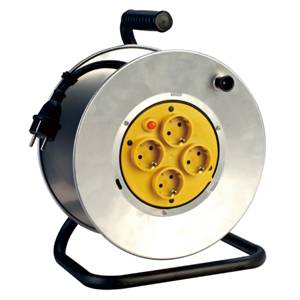
The brief anchor for this guide’s hero image — CE GS RoHS Germany Waterproof Cable Reel IP44 (Shuangyang) — is the IP44-rated, CE / GS / RoHS-certified flagship product in Shuangyang’s cable-reel line for German wholesale. The IP44 rating is independently tested, the CE declaration of conformity is filed under the EU Low Voltage Directive 2014/35/EU and the EMC Directive 2014/30/EU, the GS mark is issued by a German accredited body, and the RoHS compliance covers the EU Directive 2011/65/EU restriction of hazardous substances.
Electrical Protection — Thermal Cutout, RCD, Surge, and Earth Continuity
The electrical-protection layer is what separates a cable reel that protects the user from a cable reel that does not. Four components:
Thermal cutout: a bi-metallic thermal switch that opens the live conductor when the cable temperature exceeds roughly 70 °C, triggered either by sustained over-current or by the cable wound on the drum overheating because it cannot dissipate heat. A quality thermal cutout is resettable, accessible without tools, and tested to 10,000 trip cycles.
RCD (residual-current device) / PRCD (portable RCD): an RCD or PRCD that trips at 30 mA earth-leakage current is the EU default for construction-site portable equipment. A reel without an RCD/PRCD is a 2026 EU construction-site liability, not a product.
Surge protection: a metal-oxide varistor (MOV) surge arrestor is an add-on, not a default, but is increasingly common on 2026 EU reels sold into solar / EV-charger-adjacent jobsites. A reel with surge protection has a labelled SPD (surge protective device) and a Type 2 or Type 3 SPD classification per IEC 61643-11.
Earth continuity: the earth conductor in the cable must be continuous through the slip-ring, the frame, and the inlet socket, with a measured resistance below 0.3 Ω. A reel with an inadequate earth continuity is a quality warning that the OEM’s QC program has gaps.
A buyer who evaluates a cable reel by thermal cutout, RCD, surge, and earth continuity is buying a reel that protects the user; a distributor who evaluates only by cable spec is buying a hazard.
Cable-Reel Procurement Workflow — From Specification to PO
A cable reel procurement workflow that lands a defensible PO has six steps:
1. Specification lock: write the seven-layer specification stack above into a single document with the regulatory standards referenced (IEC 61242, EN 61316, IEC 60529, EN 50525-2-21).
2. Sample evaluation: request three reels from each candidate OEM, including the worst-case cable length variant (typically 50 m H07RN-F 3G2.5) and verify drum diameter, retraction cycles, slip-ring material, IP rating, thermal cutout, and earth continuity.
4. Compliance file audit: request the CE declaration of conformity, GS certificate (if German market), RoHS compliance file, REACH SVHC declaration, and IEC 61242 / EN 61316 test report from the OEM.
5. Cost model: build a total-cost-of-ownership model including per-reel price, expected service life (typically 5 years for IP44 reels, 8 years for IP54 reels, 10 years for IP65 reels), warranty terms, replacement-part availability, and end-of-life recycling.
6. PO with specification: write the PO with the seven-layer specification stack embedded as a contractual requirement, not as a wishlist.
A procurement team that walks those six steps is the team that does not have to apologize in writing after a reel failure on site.
Total Cost of Ownership — Why the Cheapest Cable Reel Is the Most Expensive
The cheapest cable reel on the EU market is rarely the lowest-cost reel over a 5-year contract. Three drivers:
Service life: a 16 A IP44 reel in the upper quartile of the EU market has a service life of 5 years; a reel in the lower quartile has a service life of 18 months. A buyer who pays 30 % more per reel for the upper-quartile reel is paying 30 % more for a 3× longer service life, which is roughly 60 % lower annualized cost.
Warranty terms: a reel with a 24-month warranty that covers the slip-ring, the thermal cutout, and the retraction mechanism is meaningfully different from a reel with a 6-month warranty that covers only the cable. The shorter-warranty reel is effectively a 6-month rental with no replacement option.
Replacement-part availability: a reel whose OEM stocks replacement drums, retraction springs, slip-rings, and thermal cutouts for 7 years post-purchase is a reel that can be repaired at 25 % of new-replacement cost. A reel whose OEM does not stock replacement parts is a reel that becomes e-waste at end of warranty.
A distributor or contractor who evaluates cable reels only by unit price is buying the most expensive cable reel on the market, full stop. The TCO calculation is straightforward; the discipline to walk it before signing the PO is the harder procurement outcome.
Distributor Diligence — The Five-Document Cable-Reel Checklist
A distributor-class buyer sourcing cable reels for the first time should walk a five-document diligence checklist before signing the PO. The five documents are: (1) CE declaration of conformity covering the reel as a complete assembly under the Low Voltage Directive 2014/35/EU and the EMC Directive 2014/30/EU; (2) GS certificate from an EU-accredited body if selling in Germany; (3) RoHS compliance file under EU Directive 2011/65/EU; (4) IEC 61242 / EN 61316 test report from an accredited lab; (5) OEM factory ISO 9001 quality-management certification plus a recent factory-audit report.
The five documents together answer the five questions a distributor will be asked by their downstream customer: is the reel safe, is it legal in Germany, is it free of restricted substances, has it passed the functional-safety standard, and is the factory capable of consistent quality? A buyer who can hand all five to their downstream customer is the buyer who wins the repeat business; a buyer who cannot is the buyer whose reel gets returned at the end of the season.
The OEM is expected to provide those five documents in their diligence packet, not as verbal assurance in a sales call. A distributor who accepts verbal assurance in lieu of a written diligence packet is a distributor who signs a warranty-claim season.
For the diligence packet’s quality-management reference, the OEM factory should hold ISO 9001 certification. For Germany-bound reels, the OEM should hold an active VDE or TÜV certificate on the specific reel SKU, and the dealer should request the underlying test report rather than just the certificate number. For US-bound reels, the OSHA wiring-methods standard 29 CFR 1926.405 governs jobsite GFCI / GFC protection, and the dealer should ensure the reel GFCI test procedure matches the OSHA cadence. The CE marking under the EU Low Voltage Directive framework is the umbrella authorization for the EU market. For European market access beyond the CE mark, the ENEC mark (ENEC) is the pan-European voluntary third-party certification scheme for luminaires and similar electrical products, and a reel carrying the ENEC mark has been tested to a single EN standard that is recognized across all 30 ENEC member states. The IEC 60364-5-52 voltage-drop limits referenced earlier apply in parallel to the CE-marked reel.
For a first-time distributor evaluating a cable-reel OEM for a 2026 EU construction-market launch, the indoor cable reels (Shuangyang) catalog is the starting point for the indoor commercial SKU line, the indoor 15 m mini cable reel (Shuangyang) is the compact retractable SKU for jobsite power distribution, and the Request a Quote (option 22) — Contact Us (Shuangyang) page is the distributor-inquiry entry point.
—
FAQ
Q1: What is the difference between H07RN-F and H05VV-F cable on a construction-site cable reel?
A1: H07RN-F is a rubber-sheathed flexible cable with a chloroprene (neoprene) jacket rated for oil, abrasion, and temperature from −25 °C to +60 °C. It is the EU construction-site default for 16 A reels. H05VV-F is a PVC-jacketed light-duty cable rated only for indoor dry conditions; it will crack at sub-zero temperatures and is not appropriate for outdoor construction use. A buyer who accepts PVC-jacketed cable on a construction reel has signed up for a season-2 warranty-replacement cycle.
Q2: What IP rating should I specify for a 2026 EU construction-site cable reel?
A2: IP44 for indoor / sheltered-outdoor reels (covered scaffold, indoor commercial, covered outdoor), IP54 for unprotected outdoor reels (open scaffold, exposed yard). IP65 is a niche spec for food-processing / chemical-washdown environments and is not required on a standard EU construction site. The IP Code is defined in IEC 60529; a reel labeled IP44 has been tested by the 0.8 mm nozzle, 1 L/min, 10-minute methodology.
Q3: What is the functional-safety standard for a cable reel?
A3: IEC 61242 (cable reels for household and similar purposes) and its European adoption EN 61316. A reel that does not reference IEC 61242 / EN 61316 in its CE declaration of conformity has not passed the EU functional-safety standard.
Q4: What voltage drop is acceptable on a 50 m cable reel?
A4: The target voltage drop is below 4 % per IEC 60364-5-52 for low-voltage electrical installations. A 50 m H07RN-F 3G1.5 carrying 16 A at 230 V drops roughly 18 V end-to-end — that is 7.8 %, well past the 4 % target. The correct specification is H07RN-F 3G2.5 for any 16 A reel over 25 m, or 3G4.0 for any 16 A reel over 40 m.
Q5: What is the difference between an RCD and a PRCD on a portable cable reel?
A5: An RCD (residual-current device) is a fixed or DIN-rail-mount device; a PRCD (portable RCD) is a plug-in or in-line device for portable equipment. A 30 mA-pedestal PRCD is the EU default for construction-site portable equipment. A reel without an RCD/PRCD is a 2026 EU construction-site liability, not a product.
Q6: What is the warranty term I should require from a cable reel OEM?
A6: 24 months is the EU construction-site minimum acceptable. A reel with a 6-month warranty that covers only the cable is effectively a 6-month rental with no replacement option. The warranty should cover the slip-ring, the thermal cutout, and the retraction mechanism — not just the cable.
Q7: What is the service life of an IP44 cable reel on a 2026 EU construction site?
A7: An IP44 reel in the upper quartile of the EU market has a service life of roughly 5 years; a reel in the lower quartile has a service life of roughly 18 months. IP54 reels should last up to 8 years; IP65 reels up to 10 years. A buyer who pays 30 % more per reel for the upper-quartile reel is paying 30 % more for a 3× longer service life, roughly 60 % lower annualized cost.
Q8: What is the regulatory pathway for a cable reel sold into Germany?
A8: The reel must carry a CE mark under the Low Voltage Directive 2014/35/EU and the EMC Directive 2014/30/EU; the GS mark issued by a German accredited body is the second-tier certification; RoHS compliance under EU Directive 2011/65/EU is the third-tier certification. A buyer selling into Germany should request the CE declaration of conformity, the GS certificate, and the RoHS compliance file from the OEM as part of the diligence packet.
Q9: What replacement-part availability should I require from a cable reel OEM?
A9: A 7-year post-purchase stock of replacement drums, retraction springs, slip-rings, and thermal cutouts. A reel whose OEM does not stock replacement parts is a reel that becomes e-waste at end of warranty; a reel whose OEM stocks parts for 7 years is a reel that can be repaired at 25 % of new-replacement cost.
Q10: What MOQ tier should a distributor first-time-sourcing a cable reel line expect?
A10: For stock SKUs, the standard MOQ is 500 pieces per SKU, which lets a new distributor validate the SKU in one EU construction season without overcommitting cash. For OEM-customized SKUs with distributor-owned artwork and IFU language set, the standard MOQ is 5,000 pieces for the first production run, with lead time 30–45 days from PO to ex-works. Lead time from PO to ex-works for stock SKUs is typically 20–35 days. —
Post time: Sep-29-2026