
- A 16A CEE plug and a 32A CEE plug are not interchangeable simply because they share the same general CEE format.
- The current rating must match the complete circuit, including the socket, cable, plug, protective device, and connected equipment.
- Voltage, phase, frequency, pole arrangement, and clock position are essential compatibility checks.
- Use environmental protection and cable flexibility as selection criteria for outdoor, construction, and industrial work.
- Always verify the final assembly against the applicable installation rules and the manufacturer’s technical documentation.
CEE industrial plugs are selected by more than amperage: the connector must match the equipment load, supply configuration, installation method, and operating environment. The IEC 60309 standard family covers industrial plugs, socket-outlets, and couplers, including 16 A and 32 A current-rated configurations; its official standards search is available through the IEC Webstore. This guide explains when a 16A CEE plug is appropriate, when a 32A CEE plug is justified, and how to avoid common specification errors.
What Is the Difference Between a 16A CEE Plug and a 32A CEE Plug?
The primary difference is the nominal current rating of the connector and the circuit for which it is intended. A 16A CEE plug is designed for a circuit rated at 16 amperes, while a 32A CEE plug is designed for a circuit rated at 32 amperes. These labels describe the connector’s intended current category; they do not guarantee that every connected machine will safely draw that current under every condition.
A higher-rated plug is not automatically a safer replacement for a lower-rated connector. The plug, socket, cable, terminals, switchgear, and protective device must form a coordinated system. If a machine is supplied through a circuit that is protected and wired for 16 A, installing a 32A plug does not increase the circuit’s safe capacity.
| Selection factor | 16A CEE plug | 32A CEE plug | What must be verified |
|---|---|---|---|
| Nominal current category | 16 A | 32 A | Equipment nameplate and circuit design |
| Typical selection logic | Lower-load equipment and distribution points | Higher-load equipment and distribution points | Maximum continuous and starting current |
| Interchangeability | Use only with matching rated accessories | Use only with matching rated accessories | Voltage, phase, poles, and clock position |
| Installation consequence | Requires a circuit coordinated for 16 A | Requires a circuit coordinated for 32 A | Cable, protective device, terminals, and enclosure |
How to Choose the Correct CEE Industrial Plug Specification
Start With the Equipment Nameplate
The equipment nameplate is the first specification reference because it identifies the rated voltage, phase arrangement, frequency, and current or power requirement. Do not select a connector from wattage alone when the machine has a motor, compressor, transformer, heating element, or variable-speed drive. Starting current, duty cycle, and power factor can affect the actual circuit requirement.
For procurement teams, request the complete electrical input data before asking a supplier to quote. A useful specification sheet should identify the rated current, operating voltage, number of phases, frequency, pole arrangement, grounding requirement, cable type, cable cross-section, ingress protection requirement, and intended market.
Match Voltage, Phase, and Clock Position
Current rating is only one part of CEE connector compatibility. A plug with the correct amperage can still be unsuitable if its voltage or phase configuration does not match the socket or supply system.
Clock position is a coding method used by industrial connectors to distinguish configurations. The position of the protective contact relative to the connector body helps prevent connection to an incompatible supply. Buyers should specify the required clock position rather than assuming that a visually similar connector will fit safely.
- Confirm the nominal supply voltage and frequency from the installation documentation.
- Confirm whether the equipment is single-phase or three-phase.
- Confirm the number of contacts and the protective-earth arrangement.
- Confirm the clock position required by the local system or existing socket.
- Check that the plug and socket have matching current and voltage markings.
Check the Cable and Termination Requirements
The cable must be suitable for the connector’s terminals and for the mechanical conditions of use. A cable that is electrically adequate may still be unsuitable if its outer diameter does not fit the gland or if repeated flexing causes damage at the entry point.
For a 16A CEE plug, review conductor size, insulation type, flexibility, stripping requirements, and terminal capacity. For a 32A CEE plug, pay particular attention to cable diameter, bend radius, termination torque, and strain relief because the assembly may be physically larger and used with heavier-duty equipment. The final conductor selection must follow the applicable electrical code and installation conditions rather than a generic product comparison.
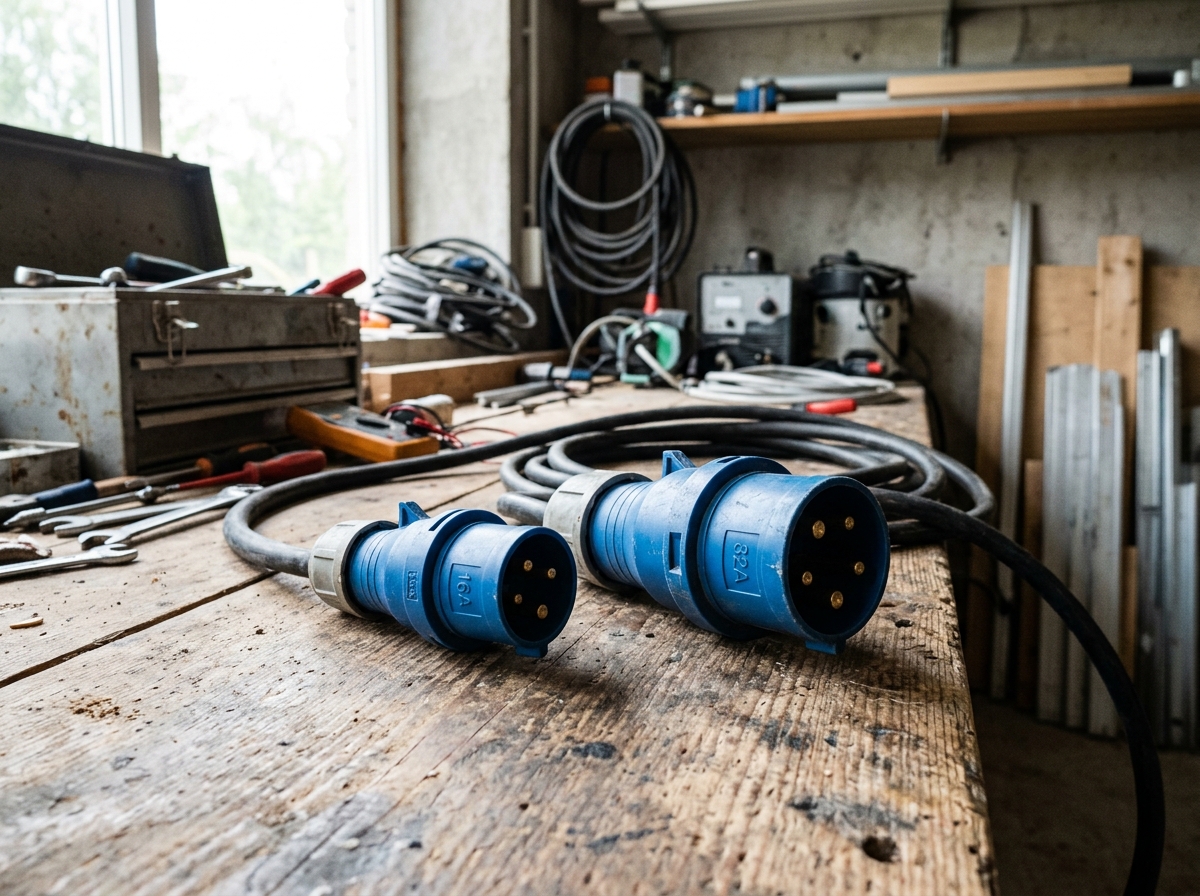 16A Versus 32A CEE Plugs in Real Operating Environments
A 16A CEE plug is usually the practical choice when equipment demand, circuit protection, and portability all fit the lower current category. Examples may include portable tools, compact site equipment, small pumps, temporary distribution boards, and light industrial accessories, provided the voltage and phase arrangement are correct.
A 32A CEE plug is appropriate when the connected load or distribution design requires the higher current category. It is commonly considered for larger portable machines, heavier-duty site distribution, workshop equipment, and industrial systems with greater input demand, subject to the equipment manufacturer’s instructions and the installation design.
Outdoor and construction applications require environmental and mechanical selection in addition to current selection. Consider ingress protection, impact resistance, UV exposure, oil contact, dust, moisture, repeated plugging, cable dragging, and storage conditions. The UK Health and Safety Executive electrical safety guidance emphasizes controlling electrical risks through suitable equipment, inspection, maintenance, and safe systems of work.
| Application condition | 16A option considerations | 32A option considerations | Primary risk to control |
|---|---|---|---|
| Portable workshop tool | Check running and starting current | Use only when the tool and circuit require it | Overload or unsuitable protection |
| Temporary construction supply | Prioritize portability and cable handling | Prioritize distribution capacity and mechanical durability | Impact, moisture, and damaged cables |
| Outdoor event equipment | Verify weather exposure and connection layout | Verify distribution planning and load balancing | Water ingress and unauthorized connection |
| Fixed industrial equipment | Check whether the lower rating limits operation | Check terminal access and installation space | Incorrect coordination with the supply circuit |
Safety and Compliance Checks Before Ordering
A compliant connector selection begins with system coordination, not with the plug body alone. Electrical safety regulators consistently advise using suitable equipment, preventing damage, and ensuring inspection and maintenance are appropriate for the environment. The U.S. Occupational Safety and Health Administration electrical safety resources provide official guidance on electrical hazards, safe work practices, and equipment considerations.
Ask the supplier for technical documentation that identifies the rated current, voltage range, frequency, pole configuration, degree of protection, terminal capacity, permissible cable range, operating temperature, and applicable test information. If the product is intended for export, documentation should also identify the market-specific compliance pathway without implying that one approval automatically covers every country.
Do not rely on a plug’s color as the only identification method. Color conventions can help users recognize voltage families, but the marking, configuration, and installation documentation remain decisive. The connector should also be inspected for cracks, deformation, loose terminals, damaged seals, overheating, and evidence of arcing before continued use.
Common Selection Errors With CEE Industrial Plugs
- Choosing by amperage only: A correct current label cannot compensate for an incorrect voltage, phase, pole arrangement, or clock position.
- Using a 32A plug to solve an overloaded 16A circuit: The circuit rating must be redesigned by a qualified professional; changing the connector does not increase conductor capacity.
- Ignoring inrush current: Motors and compressors may need a different circuit assessment from resistive loads with similar running current.
- Overlooking the enclosure environment: Indoor and outdoor use can require different protection, sealing, materials, and cable-entry arrangements.
- Skipping termination checks: Poor stripping, loose terminals, incorrect torque, or inadequate strain relief can create heat and mechanical failure.
Procurement Checklist for 16A and 32A CEE Plugs
A clear purchase specification reduces sample revisions, installation delays, and incompatibility claims. Send the supplier a complete application brief rather than only requesting a plug by current rating.
- Required current category: 16 A or 32 A.
- Rated voltage, frequency, and phase arrangement.
- Number of poles and protective-earth configuration.
- Clock position and mating socket details.
- Required ingress protection and environmental exposure.
- Cable material, flexibility, approximate outer diameter, and termination range.
- Operating temperature, impact, oil, dust, and UV conditions.
- Target market, required documentation, packaging, labeling, and customization needs.
For original equipment manufacturers and distributors, sample approval should include mechanical mating, terminal fit, cable retention, visual marking, and a review of test documentation. A factory with product development and testing capability can help translate the application brief into a repeatable specification, but the buyer remains responsible for confirming that the final assembly meets the installation requirements in the destination market.
FAQ
Can a 32A CEE plug be used on a 16A circuit?
Not as a way to increase the circuit capacity. The complete circuit must be designed, wired, and protected for the selected rating. A larger connector does not make a lower-rated cable or protective device suitable for a higher load.
Is a 16A CEE plug suitable for every portable tool?
No. Check the tool’s rated input, starting behavior, supply voltage, phase arrangement, and the circuit protection. A portable tool may require a different specification even when its running power appears modest.
Does a higher current rating mean better performance?
No. The current rating indicates the connector category and system capacity for which it is intended. It does not by itself improve the machine’s output, efficiency, or reliability.
What information should be included in a CEE plug inquiry?
Include current rating, voltage, frequency, phase, pole configuration, clock position, protection requirement, cable details, application environment, destination market, packaging, and documentation requirements.
Why do voltage and clock position matter?
They help prevent incompatible connections. Two connectors may appear similar while serving different electrical systems. Always match the marking and configuration of the plug, socket, and supply.
Which is better for construction sites, 16A or 32A?
Neither is universally better. A 16A CEE plug may suit portable lower-load equipment, while a 32A CEE plug may suit higher-load distribution or machinery. The correct choice follows the site distribution design and equipment data.
What should be checked before using an industrial plug outdoors?
Check the protection rating, seals, cable entry, mechanical condition, flexibility, strain relief, and suitability for moisture, dust, impact, temperature, and repeated movement. Damaged or overheated connectors should be removed from service and assessed by a qualified person.
About the Manufacturer
Soyang Group is an electrical accessories manufacturer with experience in timers, plugs and sockets, extension leads, cable reels, and related connection products. Its portfolio supports retail, industrial, outdoor, and engineering applications, with product development, testing, automated production, export experience, and OEM/ODM cooperation for distributors and brand owners. Buyers can request application-specific specifications, samples, documentation, packaging, and production support through the manufacturer’s official website.

Post time: Sep-29-2026