
We manufacture power cords, extension cords, extension sockets and cable reels in Cixi, Ningbo, and this is a question importers and retailers ask every week. The honest answer is that the two routes are not margin against risk, they are margin against compliance cost, and the calculation is only finished once the configuration is fixed.
What follows covers what changes when a cord carries your brand instead of ours, what the catalogue lets you compare, and what to write into the order.
What private label actually changes
The physical product changes little; the legal and commercial position around it changes completely. When a retailer buys a branded cord, the brand that has spent years on approvals and packaging carries the compliance history. When the same retailer buys the identical construction under its own name, it becomes the party responsible for that product in its market, with all the paperwork and exposure that implies.
That is a formal position rather than a commercial one. In the EU, the general product safety regulation puts the technical documentation, the risk analysis and the traceability obligations on the party placing the product on the market under its own name or trademark, and it gives online marketplaces defined duties to check that information. In the United States, electrical conductors and equipment are required to be approved as defined in 29 CFR 1910.303 before use. Because the brand on the box identifies the responsible party, a private label programme is a compliance transaction before it is a margin transaction.
What the buyer gains is control of the retail price, the assortment and the packaging, and the ability to differentiate on something other than a name already on the shelf. What the buyer takes on is the file, the registrations, the artwork, the quality control and the field-service conversation.
The margin stack, described honestly
In a low-price accessory the retail margin is real but it is not the largest line on the private label profit and loss account. Four cost families decide the outcome, and all four are visible before the first order.
- Certification. A mark on one product does not cover a different plug, socket, length or cross-section, so a private label range needs a scope check per configuration.
- Registration. Producer registration for waste electrical equipment is a recurring, per-market cost under the waste electrical equipment rules, whether or not the product is private label.
- Packaging and artwork. A private label cord usually needs its own card or box, barcode and artwork approval cycle, and for a low price item that work is a meaningful share of the economics.
- Quality and field service. Inspection, returns and recall provision sit with the brand owner, and a field issue on a cord is a safety conversation.
The commercial parameters on our side are published: supply ability of 500,000 pieces per month for the industrial extension socket line and 9,000,000 metres per month for the European cord line, a lead time of 25 days after receipt of deposit, an estimated 60 days for quantities of 1 to 10,000 pieces with the schedule negotiated above that, and packaging in a PE bag with a card unless specified otherwise. Logo printing is available, which is why private label is a normal route here.
Five levers move the unit economics, and only one is the retail price. Cable cross-section and length, because the conductor is the largest material and scales with every metre. The plug and socket set, where CEE, Schuko, flat two pin and ninety degree variants carry different components and approvals. The protection class, where IP20 and IP44 are not interchangeable. Packaging, where a PE bag with a card is a cost and your own printed box another with an approval cycle attached. And certification scope, invisible until it is not covered.
Because capacity is not the constraint, the constraint on a private label programme is the amortisation of certification and artwork over the volume you can actually sell. That is the calculation to run before you decide, and it is easier to run on the published lead times and volumes than on a catalogue price.
What the published configurations let you compare
Every row below is a separate product with its own certification list, so the comparison is configuration against configuration, not private label against a generic branded cord.
| Configuration | Published specification | Published certification list | Packaging and terms | What it means for a private label brief |
|---|---|---|---|---|
| Two way IP20 extension cord | H05VV-F 3G1.0/1.5, lengths 10, 25, 50 m, IP20 socket | CE, GS, S, RoHS, REACH, PAHS | PE bag with card; 25 days after deposit; 9,000,000 m per month | The mainstream household private label line, where artwork and packaging cost most against unit price. |
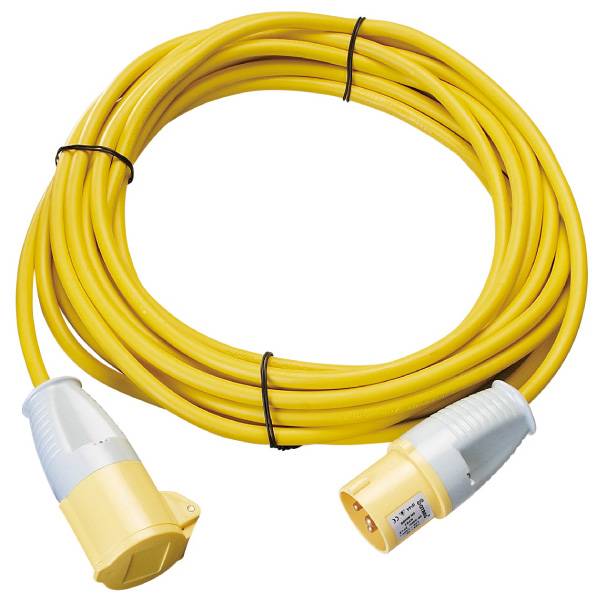
| Industrial extension cord with CEE plug and socket | Rubber cable to VDE style, CEE 2P+E, 16 A-4h, IP44, yellow; rated 250 V, 16 A | CE, S | PE bag with card; 25 days after deposit; 500,000 pieces per month | Fewer marks, and a safety argument that depends on the protection class, so scope must be checked per build. |
| Cable reels, indoor, outdoor and industrial | Four way plastic small indoor reel, 10 m and 50 m versions, steel plate and anti-twist frames, IP20 cord reel | Defined per reel model | Socket count, cable length and frame; some models add locking mechanisms or wheels | A reel is a separate family with its own file, so approvals cannot be shared with a cord line. |
The catalogue also lists two pin flat and Schuko cords, CEE 90 degree variants, five pin CEE cords and three way German multi sockets, which matters for a buyer building a range, because each variant must be checked against the certification scope.
The four risks that actually move
Risk on an extension cord is not abstract: it arrives attached to a configuration, a market and a document you may or may not hold.
Certification scope. The manufacturer publishes company approvals including CE, GS, D, N, S, NF, ETL and VDE, and separately publishes a certificate list for each product. Because those are different statements, the practical question is always which marks cover the exact model, cable and plug combination ordered.
Documentation and traceability. The EU framework expects the manufacturer to draw up technical documentation based on an internal risk analysis, to keep identification and traceability records, and to keep them current. The supplier’s records are the raw material for your own file, and a supplier who cannot hand them over quickly is telling you something.
Registration and market access. Waste electrical equipment rules place registration and reporting obligations on producers, which for a multi-market retailer becomes a recurring cost per market times the number of placing entities.
Field exposure. A cord that overheats, a socket that fails, a reel that trips: the conversation afterwards is with the brand, not the factory. Because you either accept that consciously or buy a branded product, it belongs in the decision, not the fine print.
Where branded wins
There are three situations where buying a branded cord is the better trade, and none of them is about unit price.
The first is volume: if you cannot amortise certification and artwork over the units you will sell, the branded route carries that cost for you. The second is category acceptance, because a national brand on an electrical accessory is part of why the shopper trusts the box. The third is evidence: an established approval record and 100 percent testing before delivery give you a shorter argument with a market surveillance officer and a retailer auditor.
On our side that evidence has a shape. The group was established in 1986 and operates from roughly 120,000 square metres of floor area in Cixi, Ningbo, with about 85,000 square metres of construction area, ten R&D staff and over 100 quality control staff, and publishes that all products are tested before delivery. Power cords, extension cords and cable reels are the main business, the published approvals include CE, GS, D, N, S, NF, ETL and VDE, and the company works with VDE Global Service in Germany to protect the trademark.
That is worth stating plainly: a certification mark is itself intellectual property, and using it outside the scope it was granted for is not a shortcut.
A decision framework that works
Choose private label when you have the volume to amortise compliance, the capability to hold a technical file, the registrations for your markets, and an assortment rationale that is not only price. Choose a branded cord when the volume is small, the assortment must be broad and fast, the shelf position depends on trust more than price, or you would rather not hold the recall conversation.
In both cases, do the configuration and the paperwork before the price: the configuration decides which certificates apply, which registrations you need and how the product is packaged, and it is the only part that can be reversed cheaply.
How to brief a supplier on a private label extension cord
Six items, in this order.
- Fix the configuration: plug type, socket type and count, cable length, cross-section, protection class, packaging and markets.
- Confirm the certification scope per configuration and market, and ask for the reports behind each mark.
- Request the documentation pack: data sheet, test reports, declarations of conformity and batch traceability records.
- Price compliance separately: certification scope, producer registration, packaging and artwork, and your own inspection and returns provision.
- Lock packaging, labelling, barcode and artwork approval, and confirm the published route for guest logos.
- Agree change control and field-issue handling in writing: who may change a component, who holds the records, who leads a recall.
Frequently asked questions about private label extension cords
Can a private label extension cord carry my own brand?
Yes. The manufacturer publishes that guest logos can be printed on the product, so private label is normal in this category. What changes is the paperwork: the party placing the product on the market under its own name or trademark becomes the manufacturer for compliance purposes, so the file and any field action sit with you.
How long does a private label extension cord order take?
The published lead time is 25 days after receipt of deposit for catalogue configurations, with an estimated 60 days for quantities of 1 to 10,000 pieces and the schedule negotiated above that. Add artwork approval, certification scope and registration steps on your side, because those sit outside the factory schedule.
Which certifications does a private label extension cord need in Europe?
The EU framework is layered: electrical safety under the Low Voltage Directive, substance restrictions under RoHS, producer registration for waste electrical equipment, and the general product safety regulation for documentation, traceability and marketplace obligations. A mark on the carton is the visible evidence, not the file behind it.
Does a cable reel need its own certification and testing?
Yes. The reel catalogue is a separate family with indoor, outdoor and industrial versions, and the differences between them are the protection class, the socket count, the cable length and the thermal and overload protection. Those are the features a certification report is written around.
Who carries the risk if a private label cord fails in the field?
The party that markets it, and the EU framework is built so the responsible economic operator is identifiable. That is why the documentation pack, batch traceability and the change-notification rule are commercial terms in a private label negotiation, and why the United States treats electrical equipment as needing approval before use.
Does private label always give a better margin?
Not automatically. The retail price is only one side: certification, producer registration, your own packaging and artwork, quality control, returns and recall provision all move onto your balance sheet. In a low price accessory those items can absorb the margin the branding was meant to create.
Bring the configuration, not the question
The most useful enquiry is a specification, not a question about private label versus branded. Send the plug, socket, length, cross-section, protection class, packaging and target markets, and we will come back with the published configuration that matches, the marks that cover it, the applicable order terms and the documentation you will receive.
We have manufactured power cords, extension cords, extension sockets and cable reels since 1986, with published supply ability of 500,000 pieces and 9,000,000 metres per month and a 25 day lead time after deposit. Review our cable reel catalogue, the industrial extension cord and the two way IP20 extension cord, then send your specification.
About the publisher
Zhejiang Shuangyang Group Co., Ltd. was established in 1986 and is a privately owned manufacturer in Cixi, Ningbo, Zhejiang, one hour from Ningbo harbour and airport and two hours from Shanghai. The group publishes a floor area of about 120,000 square metres, about 85,000 square metres of construction area, ten R&D staff and over 100 quality control staff, and more than ten new products designed a year. Main products are timers, sockets, flexible cables, power cords, plugs, extension sockets, cable reels and lighting, with power cords, extension cords and cable reels as the core business, supplying European and American markets under published approvals including CE, GS, D, N, S, NF, ETL, VDE, RoHS, REACH and PAHS.
Post time: Nov-20-2026