
Key Takeaways
- OEM gives you complete design ownership and competitive differentiation — at the cost of higher tooling investment and longer development timelines
- ODM enables faster market entry with zero tooling cost — but your product shares design rights with the factory and potentially other buyers
- The right choice depends on your brand maturity stage, volume projections, IP requirements, and competitive positioning strategy
- Hybrid approaches (ODM with proprietary modifications, platform + skins) often deliver the best risk-adjusted outcome for growing brands
- Volume threshold for economically defensible OEM is typically 3,000-5,000 units per SKU annually for standard extension socket products
We have had the same conversation dozens of times with brand owners and procurement managers considering an extension socket or power distribution product program: “Should we go OEM or ODM?” The answer is never universal — it depends on the brand’s competitive position, its capital position, its volume commitments, and what it is actually trying to achieve in the market. But the conversation itself is worth having carefully, because the choice made at the program design stage shapes every subsequent decision: tooling investment, time to market, margin structure, IP protection, and long-term competitive sustainability. This guide is designed to help you make that decision with a clear framework rather than a generic preference.
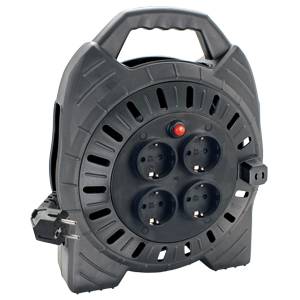 Indoor mini cable reel — one of the extension socket and power distribution product categories where the OEM vs ODM decision most directly shapes a brand’s competitive position. Image: Shuangyang Group product archive.
Understanding the Two Models Before You Choose
Before evaluating which model fits your brand, it is worth being precise about what each actually means — because the terms are used loosely in the industry, and the practical implications of each arrangement matter enormously for the decisions that follow.
What OEM Actually Means in Extension Socket Sourcing
In an OEM arrangement for extension sockets and power distribution products, you — the brand owner — provide the complete product specification. This means your technical drawings, your designated material standards, your required safety features, your target certifications, and your exact dimensional and functional requirements. The factory manufactures to your specification. You own the tooling (or fund its creation and hold it in escrow). The factory operates under a non-disclosure and non-compete agreement that prevents them from offering your exact product design to any other buyer.
In practical terms, OEM means the factory is a manufacturing services provider, not a product designer. You carry the engineering responsibility; they carry the production execution responsibility. This is the model used by established consumer electrical brands when they launch proprietary product lines — the brand invests in the product development, and the factory converts that development investment into physical product under controlled conditions.
OEM at a Glance
Design ownership: Brand owner (you)
Tooling investment: $15,000-$60,000 per major mold (varies by complexity)
Development timeline: 4-8 months from spec to production sample
Per-unit cost: Lower at volume, but with tooling amortized in
IP protection: Complete — factory is contractually restricted
Best for: Brands requiring design differentiation and IP ownership
What ODM Actually Means in Extension Socket Sourcing
In an ODM arrangement, the factory provides the product design from its existing catalog. You select a product that already exists, apply your brand branding (logo, color, packaging), and the factory manufactures it under your private label. The design IP belongs to the factory — they developed it, they own it, and they can offer it to other buyers. Your contribution is the market positioning, branding, and channel relationships; the factory’s contribution is the product design, manufacturing capability, and often the certifications.
For extension sockets and cable reels specifically, an established ODM manufacturer like Shuangyang Group maintains catalogs of tested, certified products across a wide range of configurations — different socket counts, cable lengths, surge protection ratings, cord types (PVC vs rubber), and international plug standards. The ODM value proposition is that you can access this catalog, select a product, and be in production within weeks rather than months, without any tooling investment.
ODM at a Glance
Design ownership: Factory
Tooling investment: None — production uses factory’s existing tooling
Development timeline: 2-6 weeks from product selection to production sample
Per-unit cost: Zero tooling, but per-unit margin depends on factory’s catalog pricing
IP protection: Structural — other buyers can source the same base design
Best for: Brands prioritizing speed to market and capital efficiency
The Decision Framework: Five Variables That Determine the Right Choice
In our experience working with brand partners across Europe, Southeast Asia, the Middle East, and Latin America on extension socket and power distribution programs, the OEM vs ODM decision resolves predictably once you evaluate five specific variables. Here is the framework we use in our own partner conversations.
Variable 1: Your Brand’s Current Competitive Position
If you are entering a market as a new entrant with no established brand equity, the economics of OEM are difficult to justify — you do not yet have the channel relationships, brand recognition, or pricing power to recover the tooling investment through premium product positioning. In this situation, ODM is the rational choice: get to market quickly, build brand awareness with an accessible product, and plan an OEM transition as your volume and margin structure mature.
If you are an established brand defending market share against well-resourced competitors, OEM’s IP protection becomes more valuable — you are investing in product differentiation that your competitors cannot easily replicate through the same factory. In this situation, the question is not whether you can afford OEM investment, but whether you can afford not to invest in differentiation that protects your margin.
Variable 2: Your Volume and Margin Structure
The most concrete variable in the OEM vs ODM decision is the number. We typically advise brand partners to calculate the tooling amortization across their projected annual volume: if the tooling investment (say, $30,000 for a major injection mold for a multi-outlet extension socket) divided by projected annual volume (say, 5,000 units) gives you an incremental tooling cost per unit of $6, and your target retail margin requires a per-unit cost below a certain threshold, then you need to evaluate whether the differentiation premium achievable through OEM is worth that $6 per unit.
For standard extension socket products in the mid-market segment, the per-unit OEM premium over ODM (accounting for tooling amortization) typically ranges from $1.50 to $4.00 per unit depending on product complexity and volume. For premium or specification-grade products where the brand commands a higher retail price, this premium is easily absorbed. For budget-segment products competing primarily on price, the OEM premium may be unworkable.
Variable 3: Your IP and Differentiation Requirements
Some brands need OEM for reasons that are not primarily financial. If you have filed or are planning to file design patents in your target markets, you need an OEM arrangement where you hold the design rights. If your product has a distinctive visual identity that is central to your brand’s market recognition — a specific form factor, a proprietary color, a unique user interface design — you need OEM to prevent competitors from sourcing the same product and undercutting you on price with an identical product under a different brand.
For brands that have not yet built significant product design IP, ODM is often acceptable from an IP perspective — but only if the brand’s strategy is to compete on branding, channel relationships, and service rather than on product design exclusivity. If you are comfortable with your product being structurally identical to a competitor’s product sourced from the same ODM factory, and you plan to differentiate on price, speed, or brand reputation instead, ODM is a perfectly rational choice.
Variable 4: Your Time to Market Requirement
ODM programs typically move from product selection to production sample in 2-6 weeks. OEM programs typically require 4-8 months from specification to production-ready sample. If you have a retail listing window, a seasonal buying cycle, or a contract bid deadline that requires product delivery within 60-90 days, ODM may be the only workable model regardless of the other variables. If you are building a product roadmap for a launch 12-18 months out, you have the time to do OEM correctly — and you should use that time rather than settling for an ODM product that does not fully meet your requirements.
Variable 5: Your Target Market’s Certification Landscape
Extension sockets and power distribution products require certification for every market they enter — CE marking for the European Union, UL or ETL listing for the United States, CCC for China, SASO for Saudi Arabia, and so on. These certifications are attached to specific product designs. In an ODM arrangement, the factory typically holds the existing certifications for their catalog products and can add your brand name to the certification through a factory transfer or a new test report. In an OEM arrangement, the certification is your asset — you have the testing done under your brand name and you hold the certification. For brands that view certifications as long-term brand assets (particularly important in B2B and specification channels), OEM provides cleaner certification ownership.
OEM vs ODM: Head-to-Head Comparison Across Key Dimensions
| Dimension | OEM Model | ODM Model |
|---|---|---|
| Design ownership | Brand owner — you specify, you own | Factory — you select from catalog |
| Tooling investment | $15,000-$60,000 per major mold | None — factory uses existing tooling |
| Time to first production sample | 4-8 months from specification | 2-6 weeks from product selection |
| Per-unit manufacturing cost | Lower at volume (5,000+ units/SKU/year) | Zero tooling amortized, but catalog pricing |
| IP protection level | High — factory contractually restricted | Structural — other buyers can source same design |
| Product differentiation potential | Complete design freedom | Limited to cosmetic and modular variations |
| Certification ownership | Brand holds certification directly | Certification typically held by factory |
| Minimum volume for economics | ~3,000-5,000 units/SKU/year | No minimum — accessible at any volume |
| Supply continuity risk | Low — you control the tooling and design | Moderate — factory controls design continuity |
| Best fit brand stage | Established brands, specification buyers | New entrants, private label programs, speed-first |
What Brands Actually Choose: Real-World Program Patterns
Across the dozens of extension socket and power distribution programs we manage at Shuangyang Group, certain patterns emerge consistently about which brands choose which model. These are not rules — individual circumstances always override general patterns — but they are useful reference points when you are thinking through your own situation.
Pattern 1: European Retail Brands Choose OEM for Core Line, ODM for Extensions
European retail brands with established product lines typically use OEM for their core differentiated SKUs — the flagship products that define their brand in the market — and ODM for their extended range, seasonal variants, and entry-level offerings. This mixed approach lets them protect the design equity of their core line while accessing the speed and capital efficiency of ODM for the broader product range. The practical result is a product portfolio that has clear brand identity at its center, surrounded by accessible variants that do not require bespoke investment.
Pattern 2: Middle East and Africa Distributors Prefer ODM for Speed and Flexibility
Distributors operating in Middle Eastern and African markets frequently choose ODM because their order patterns are less predictable — they need to respond quickly to government procurement tenders, seasonal demand fluctuations, and customer-specific requests for non-standard configurations. ODM’s faster lead time and lower commitment threshold align well with these market dynamics. When we see a distributor partner start with ODM and then transition specific SKUs to OEM as they develop their own product roadmap, the progression typically takes 18-36 months.
Pattern 3: North American Online Sellers Move OEM Quickly for Brand Protection
Amazon private label sellers and D2C brands in North America face a specific version of the IP problem: if you launch a product on ODM terms and it becomes a bestseller, a competitor with sufficient capital can identify the factory (through the product’s physical characteristics) and source the same product from the same factory under a competing brand. We have seen this happen to multiple brand partners. The response is to move to OEM as quickly as volume justifies it — typically within 6-12 months of identifying strong product-market fit. The OEM tooling investment becomes a competitive moat, not just a product development cost.
“Our best-selling extension socket product started as an ODM private label program. Within eight months of launch, we had identified two direct competitors sourcing the same product from the same factory. We immediately transitioned to an OEM arrangement — different color, modified internal safety module, custom packaging — and filed design patents in our primary markets. The OEM investment paid back within four months through recovered margin that the competitors could not steal, because the product was now legally distinct.” — Brand owner, European home improvement market.
Hybrid Models: How to Get OEM Benefits Without Full OEM Investment
The pure OEM vs pure ODM framing is actually a false binary for many brand programs. In practice, the most sophisticated brand partners we work with use hybrid approaches that capture the benefits of both models while mitigating the drawbacks of each. Understanding these hybrid structures before you commit to a pure model is valuable — you may find that one of them fits your brand’s situation better than either pure alternative.
Hybrid 1: ODM with Proprietary Modifications
In this model, you select an existing ODM product as your base platform, then invest in factory-managed modifications that create derivative designs exclusive to your brand. The modifications might include a custom housing color (achievable with a color masterbatch change and no new tooling), a modified socket configuration (achievable by changing insert components within the existing tooling), or an added feature module (such as integrating a USB charging module from a third-party supplier into the existing body design).
The investment in modifications is typically a fraction of full OEM tooling investment — often $3,000-$12,000 in engineering and tooling modification costs — while creating meaningful competitive separation from the base ODM product. The limitation is that your modifications are structural derivatives of the base design; you cannot fundamentally alter the form factor or create a genuinely novel product architecture.
Hybrid 2: Platform + Skins
Some of our most successful brand partners work with a single ODM base platform — for example, a 4-outlet surge-protected extension cord with 3-meter cable — and create multiple market-specific variants through cosmetic customization. One brand we work with has six variants of the same base platform, differentiated by plug type (UK, EU, US, Australia), branding (different brand names for different market segments), and packaging (retail blister, commercial bag, gift box). The total tooling investment is one platform; the commercial reach is six products.
This approach is particularly effective for brands operating across multiple international markets with different plug standards and regulatory requirements. The platform engineering investment is made once; the market-specific customization is applied as a surface layer.
Hybrid 3: OEM for Core Safety Architecture, ODM for Peripheral Features
For extension socket products where safety certification is the primary brand differentiator, some partners pursue a hybrid where the core electrical safety architecture (the internal wiring, the surge protection mechanism, the circuit breaker module) is developed under OEM terms with full design ownership, while peripheral features (the housing design, the cable reel mechanism for cable reel products, the user interface for digital timer-integrated products) are sourced from ODM base platforms.
This approach is common among brands targeting specification buyers — electrical contractors, facility managers, project developers — who care primarily about certified safety performance and secondarily about visual design. The brand’s OEM investment in the safety architecture delivers the certification ownership and performance differentiation they need for specification channel credibility, while the ODM peripheral elements keep the overall program cost manageable.
Evaluating an Extension Socket Factory’s ODM vs OEM Capability
Whether you choose OEM or ODM, the quality of the factory partnership determines whether the model you select actually delivers on its promise. An OEM arrangement with a factory that lacks precision tooling capability produces expensive products with poor consistency. An ODM arrangement with a factory that has limited engineering support produces a static product catalog with little ability to adapt to your requirements. Here is what to evaluate before committing to either model.
For ODM Programs: What to Verify
- Catalog depth and recency: Ask to see the factory’s most recent product development releases — not just their best-selling established products. A factory that has not introduced a new ODM product in three or more years may be working from an aging catalog that reflects past market conditions rather than current requirements.
- Certification coverage: Verify which certifications the factory holds for its ODM catalog products and in which markets. A factory may have CE marking for EU markets but no UL listing for US market — meaning a product that looks attractive in their catalog may require expensive additional certification before it can be sold in your target market.
- Modification engineering capability: Ask specifically whether the factory can implement proprietary modifications to an ODM base product — what is their minimum order quantity for a color modification, a component change, or a feature module addition? Factories with strong ODM programs should be able to answer these questions quickly and provide specific minimum quantities and cost impacts.
- Quality control documentation: Request the factory’s quality control process documentation for their ODM products — specifically the incoming material inspection, in-process inspection, and final product testing protocols. An ODM product is only as reliable as the factory’s QC commitment, regardless of how attractive the catalog price is.
For OEM Programs: What to Verify
- Tooling capability and precision: Visit or request detailed documentation of the factory’s tooling facility — the age of their injection molding machines, their mold-making capability (in-house vs outsourced), and their dimensional measurement equipment. Precision extension socket products require tooling precision to +/- 0.03mm on critical fit dimensions; a factory that cannot demonstrate this capability should not receive OEM tooling investment.
- Prototype development process: A competent OEM partner should be able to show you a structured prototype development process — from initial technical review and DFMEA (Design Failure Mode and Effects Analysis) through first article inspection and production validation. If a factory says “send us your drawings and we will make samples,” that is not an OEM engineering partnership; that is a quoting process.
- Certification management experience: Ask the factory to describe their experience managing product certification for OEM programs — specifically which markets they have supported, what the typical timeline and cost was, and how they handle the situation when a product fails certification testing. A factory with deep OEM experience will have a structured response to certification failures, not a defensive one.
- Long-term tooling ownership and maintenance: Confirm in the supply agreement who owns the tooling, where it is stored, and how the factory manages tooling maintenance and repair over the life of the program. Tooling that is not properly maintained degrades — dimensional drift, surface finish deterioration, accelerated wear — and the cost of re-machining worn tooling falls on whoever owns it.
Our socket and plug product category represents the product range where we have the deepest combined ODM catalog and OEM program experience — covering standard household extension sockets, industrial plug and socket configurations, USB-integrated sockets, and custom cable reel products for specialist applications. Whether your program fits ODM, OEM, or a hybrid structure, we can evaluate your requirements and advise on the most effective path.
The Decision Checklist: OEM or ODM for Extension Sockets
If you have read this far and are still unsure which model fits your situation, run through these five questions. Your answers point toward a clear default position, even if individual circumstances might modify the recommendation.
Question 1: Do you have a product design that is core to your brand identity?
If yes → OEM is likely the right default. If your brand’s identity is tied to a specific product design that you need to protect from imitation, you need design ownership. If no → ODM is a viable starting point.
Question 2: Is your target volume above or below ~3,000-5,000 units per SKU per year?
Above → OEM tooling amortization is manageable and the differentiation case is typically strong. Below → ODM’s zero-tooling model is more appropriate for the volume economics.
Question 3: Do you have a retail listing window or contract deadline within 90 days?
Yes → ODM is effectively mandatory — OEM timelines make 90-day delivery impossible in most cases. No → You have the time to choose based on strategic factors rather than time pressure.
Question 4: Are you entering a market where product certification (UL, CE, CCC) is a competitive moat?
Yes → OEM gives you cleaner certification ownership and the ability to defend your certification position independently. No → ODM certification (held by factory) may be sufficient for market access.
Question 5: Is your brand competing primarily on product design innovation or on brand/channel strength?
Product design innovation → OEM. You need design ownership to protect the innovation return on investment. Brand/channel strength → ODM or hybrid. Your competitive advantage is in the market, not in the product architecture.
Frequently Asked Questions
What is the fundamental difference between OEM and ODM for extension socket sourcing?
In OEM, you provide the complete product design and own the IP; the factory manufactures to your specification. In ODM, the factory provides the product design from its catalog and you private-label it under your brand. The choice determines who owns the design, who bears tooling investment, and how much product differentiation you can achieve relative to competitors sourcing from the same factory.
When should a brand owner choose OEM over ODM for extension sockets?
Choose OEM when your brand requires product differentiation that existing ODM catalogs cannot provide — specific socket configurations, proprietary safety features, or a design that matches your brand identity. OEM is also correct when you have filed or plan to file design patents requiring legal ownership. The trade-off is higher upfront tooling investment and longer development time, in exchange for complete design freedom and competitive protection.
What are the cost implications of OEM versus ODM for extension socket programs?
ODM programs require zero tooling investment — production uses the factory’s existing catalog tooling. OEM programs require tooling investment of $15,000-$60,000 per major mold depending on product complexity. For a standard extension socket line, OEM becomes economically defensible above approximately 3,000-5,000 units per SKU annually — enough to amortize tooling while the differentiation value exceeds the per-unit incremental cost.
Can an ODM extension socket product be truly differentiated for my brand?
Partially — through branding (custom color, logo, packaging), cable length and plug type customization within the factory’s existing range, and modular feature additions (USB ports, surge protection, timer modules). What you cannot easily change on a pure ODM product is the core structural design and internal safety architecture. If your brand’s differentiation requires structural innovation, ODM will be constraining.
How does IP protection differ between OEM and ODM extension socket sourcing?
In OEM, you own the design and the factory is contractually restricted from offering it to other buyers. In ODM, the factory retains design rights and can offer the same or substantially similar products to other buyers. The practical IP risk in ODM is not factory bad faith — it is that a commercially successful ODM product will be observed by competitors and potentially sourced from the same factory. For brands building long-term product differentiation, OEM provides structural IP protection that ODM cannot match.
What volume thresholds make OEM economically viable for extension socket programs?
In our experience, OEM becomes economically defensible at approximately 3,000-5,000 units per SKU annually — enough volume to amortize the tooling investment ($15,000-$45,000 per major mold) such that the per-unit incremental cost premium over ODM is offset by differentiation value and competitive protection. Below this threshold, ODM is typically the more rational choice unless you have a specific IP protection requirement that overrides pure economics.
What hybrid approaches exist between pure OEM and pure ODM for extension sockets?
The most common hybrid is ODM with proprietary modifications — starting from an existing ODM product and investing in factory-controlled derivative modifications that create a derivatives portfolio exclusive to your brand. Another is platform + skins — using one ODM base platform and creating multiple brand variants through cosmetic customization for different market segments. A third is OEM for core safety architecture plus ODM for peripheral features, which is common among brands targeting specification buyers who care primarily about certified safety performance.
Ready to Discuss Your Extension Socket Program Structure?
Whether your brand is better suited to OEM, ODM, or a hybrid approach depends on your specific product requirements, target markets, volume projections, and competitive positioning. Our team works with brand owners and procurement managers to evaluate these factors and recommend the partnership structure that best fits your program objectives.
Conclusion: The Model Is a Means, Not an End
The OEM vs ODM debate tends to generate more heat than light because it is framed as a philosophical choice — “Do you believe in owning your design or not?” — rather than what it actually is: a tactical decision based on your brand’s current position, your financial capacity, your volume commitments, and your competitive strategy. The brands that make this decision best are the ones who ask the right questions first: What is the brand trying to achieve? What volume can we commit to? How important is product design differentiation to our competitive position? What is our time window for market entry?
Once those questions have clear answers, the model choice is often obvious. What we have seen work in practice is brands that start with ODM to validate market demand and build initial volume, then transition specific SKUs to OEM as they develop product-market fit and can justify the tooling investment. The hybrid approaches we described — ODM with proprietary modifications, platform + skins, OEM core with ODM peripherals — exist precisely because the pure binary does not serve every brand situation optimally.
If you are in the early stages of evaluating an extension socket or power distribution product program and want a direct conversation about which model fits your brand’s specific situation, our team at Shuangyang Group is available to review your requirements and provide a specific recommendation based on our manufacturing experience across both OEM and ODM program structures.
For a full overview of the extension socket, cable reel, and power distribution product range we manufacture — and the certification coverage we maintain across major international markets — explore our socket and plug product category and indoor cable reel product specifications to understand the product range that forms the foundation of both our ODM catalog and our OEM development programs.
About the Manufacturer
Zhejiang Shuangyang Group Co., Ltd. is a manufacturer specializing in extension sockets, cable reels, timer devices, and power distribution products. The company produces digital programmable timers, mechanical timers, industrial and household extension cords, indoor and outdoor cable reels, and related electrical accessories. Shuangyang Group supplies brand owners, distributors, and OEM partners globally with products certified for major international markets including the European Union, North America, Southeast Asia, and the Middle East.
For product program discussions, contact the Shuangyang Group team at rose.luo@shuangyang-group.com or through the contact form.
Post time: Oct-20-2026