
- Compare resistive, motor, LED, and inductive load ratings separately rather than relying on one headline current value.
- Choose digital control when repeatable schedules and fine programming matter; choose mechanical control when simplicity and quick visual adjustment are priorities.
- Match enclosure protection and cable entry design to dust, moisture, impact, outdoor exposure, and cleaning conditions.
- Request test reports, wiring diagrams, installation instructions, and traceable product specifications before approving a purchase.
Industrial timer switch selection is a risk-control decision involving electrical compatibility, environmental exposure, programming needs, and regulatory documentation. The IEC explains that an IP code uses two characteristic numerals to identify protection against solid foreign objects and water, making enclosure data more useful than vague claims such as weather resistant. This guide shows commercial buyers how to compare timer switch specifications and avoid common purchasing errors.
What Commercial Buyers Should Verify First
The first decision is whether the timer will control the load directly or operate a contactor, relay, or other switching device.
Direct switching may suit a modest, well-defined load, but motors, compressors, transformers, LED drivers, pumps, and other inductive or electronically controlled equipment can create inrush or switching stress that is not represented by a simple resistive rating. A product that appears suitable for a heater may therefore be unsuitable for a motor or power supply.
Before requesting quotations, document the equipment nameplate, supply system, load type, expected switching frequency, installation location, ambient conditions, and required operating schedule. This information lets a supplier recommend a configuration instead of matching only a nominal current.
Core Specification Checklist
| Specification area | What to compare | Why it matters | Buyer evidence |
|---|---|---|---|
| Supply compatibility | Rated voltage, frequency, phase, and wiring arrangement | Prevents incorrect installation and unreliable operation | Technical datasheet and wiring diagram |
| Load capability | Resistive, motor, LED, inductive, and pilot-duty ratings | Switching stress varies by load technology | Load table or test report |
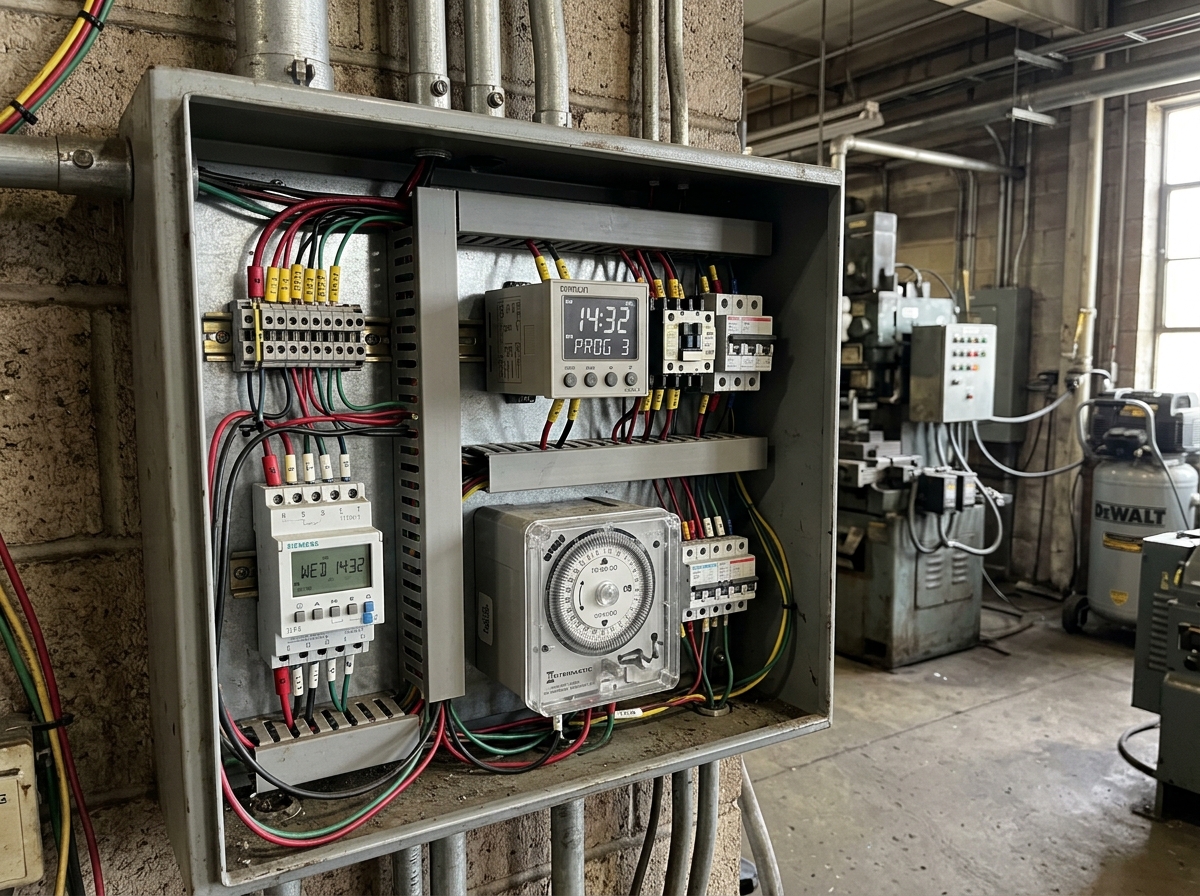
| Control method | Digital, mechanical, interval, countdown, or astronomical control | Determines programming flexibility and user training | Programming guide and sample schedule |
| Installation | Plug-in, wall-mounted, panel-mounted, or DIN-rail format | Influences enclosure, wiring, and replacement time | Dimensional drawing and terminal layout |
| Environment | IP code, temperature range, UV exposure, impact, and condensation | Determines suitability for plant rooms, sites, and outdoor areas | Enclosure rating and environmental test information |
Industrial Timer Switch Specifications: Electrical Compatibility
Electrical compatibility should be assessed from the complete load profile, not from the timer label alone.
Commercial applications often combine a timer with a contactor because the timer provides control logic while the contactor handles the equipment load. This arrangement can reduce the switching burden on the timer and simplify replacement, but it requires correct coil voltage, suppression where appropriate, overcurrent protection, and a properly documented control circuit.
Buyers should also ask how the rating was established. A credible specification identifies the applicable load category, test conditions, terminal arrangement, and intended duty. If a datasheet lists only one current value without identifying the load type, request clarification before approval.
Electrical safety also depends on installation practice, guarding, isolation, grounding, and maintenance. The U.S. Occupational Safety and Health Administration electrical safety resource provides a useful regulatory reference for workplace electrical hazards and safe work practices. It should complement, not replace, the requirements applicable in the buyer’s country.
Digital Versus Mechanical Commercial Timer Switches
Digital and mechanical timers solve different commercial problems, so the correct choice depends on schedule complexity and operating conditions.
| Control type | Typical strength | Typical limitation | Best-fit scenario |
|---|---|---|---|
| Digital | Repeatable schedules, multiple settings, and clear programmable logic | Requires programming knowledge and may depend on a backup power design | Retail lighting, HVAC coordination, irrigation, and scheduled equipment |
| Mechanical | Simple visual adjustment and straightforward operation | Fewer scheduling options and less flexibility for changing programs | Basic signage, ventilation, and routine daily control |
| Countdown or interval | Fast temporary operation without a fixed calendar program | Less suitable for complex weekly schedules | Washrooms, extraction fans, temporary process equipment, and service areas |
| Astronomical or sensor-linked | Can coordinate operation with changing daylight or measured conditions | More configuration and commissioning considerations | Exterior lighting and energy-management projects |
For a facility with different weekday and weekend requirements, a digital timer is usually easier to manage because the program can be documented and repeated. For a small service area where staff need a quick, obvious adjustment, a mechanical device may reduce training and commissioning effort. Neither type is automatically safer; installation quality and load suitability remain decisive.
Enclosure Protection and Installation Environment
Environmental selection should begin with the location’s actual hazards, including water, dust, impact, oil, sunlight, cleaning methods, and condensation.
The IEC’s standards information portal is a starting point for identifying relevant international standards. For enclosure selection, buyers should ask for the exact IP code and the standard or test basis behind it. An IP designation is not a general promise of suitability for every outdoor or industrial condition.
For example, an outdoor installation may require protection from rain, UV exposure, temperature cycling, cable strain, and accidental impact. A washdown area introduces a different risk profile from a dry warehouse. A timer inside a cabinet may need less environmental protection than a timer mounted directly on an exposed machine, but the cabinet’s own ingress, ventilation, and condensation controls must then be evaluated.
NEMA enclosure terminology may also appear in North American projects. The National Electrical Manufacturers Association enclosure standards resource can help buyers understand why enclosure classifications should be compared using the terminology required by the project specification.
Programming, Maintenance, and Failure Recovery
A commercial timer is operationally useful only when its program survives normal use and staff can recover from a power interruption or replacement.
Ask whether the device has a backup mechanism, whether the clock retains its settings after supply loss, and how the display behaves during a restart. Also confirm whether daylight-saving changes, leap-year behavior, manual override, randomization, and holiday schedules are relevant to the application. These functions should be confirmed in the manual rather than assumed from the word digital.
Maintenance teams should be able to identify the active state, override the output safely, and restore the approved schedule after service. A clear front panel, durable labels, accessible terminals, and a documented reset procedure can reduce operational errors.
Procurement Questions That Reveal Specification Gaps
- Which load categories were tested, and are motor or LED loads included?
- What happens to the output after power restoration?
- Is the timer intended for direct load switching or control-circuit duty?
- What enclosure rating and environmental test information is available?
- Which terminals, conductor sizes, and installation methods are supported?
- Are replacement units electrically and mechanically interchangeable?
- Can the supplier provide samples, drawings, packaging details, and inspection records?
 How to Compare Supplier Documentation
The strongest supplier submission connects every important claim to a document that engineering, purchasing, and maintenance teams can review.
A practical comparison file should include the product datasheet, wiring diagram, dimensional drawing, user manual, compliance declarations where applicable, test evidence, packaging specification, and change-control information. Separate confirmed specifications from optional features and from values that depend on a customized design.
For private-label or OEM projects, define the approval process before tooling or mass production. A useful process includes application review, electrical and mechanical sample approval, safety and functional testing, artwork confirmation, pilot inspection, and production release. The buyer should also agree on how revisions are identified so that an approved timer is not silently replaced by a different configuration.
Common Selection Mistakes
The most frequent purchasing mistake is treating a timer as a generic switching accessory rather than part of a complete electrical system.
- Choosing a resistive load rating for a motor, compressor, transformer, or LED driver.
- Assuming an outdoor location is acceptable without reviewing water entry, UV, temperature, and cable protection.
- Buying a digital model without confirming backup behavior and schedule recovery.
- Comparing price before confirming terminal design, installation format, documentation, and test basis.
- Using a product in a control cabinet without checking clearance, heat accumulation, and maintenance access.
When the application is uncertain, a conservative control arrangement using a properly selected contactor and documented protection may be more appropriate than direct switching. The final decision should be made by a qualified electrical professional familiar with the local code and installation conditions.
A Buyer-Friendly Decision Framework
The most reliable selection process moves from application facts to verified specifications in a fixed sequence.
- Define the controlled equipment and identify the most demanding load condition.
- Confirm supply voltage, frequency, phase, wiring, and installation format.
- Select the control logic: digital, mechanical, interval, countdown, or another required mode.
- Specify environmental exposure and the applicable enclosure classification.
- Review safety documentation, test evidence, instructions, and replacement strategy.
- Validate samples in the real installation before approving volume production.
This framework is especially useful for importers, facility contractors, electrical distributors, and private-label buyers because it creates a common language between engineering and purchasing.
FAQ
What is the most important industrial timer switch specification?
Load compatibility is usually the first priority. Confirm the supply details and the actual load type, then compare the appropriate resistive, motor, LED, or inductive rating.
Should a commercial timer switch directly control a motor?
Not automatically. A motor may create starting and switching demands that require a contactor or another control arrangement. Ask the supplier for a motor-load rating and have the circuit reviewed by a qualified professional.
Is a digital timer better than a mechanical timer?
Digital control is generally more suitable for complex, repeatable schedules. Mechanical control can be practical when the schedule is simple and staff need immediate visual adjustment.
What environmental information should buyers request?
Request the exact IP or other required enclosure classification, operating temperature information, impact and UV considerations, cable entry details, and installation instructions.
Does an IP code prove that a timer is suitable for every outdoor site?
No. The code describes specific protection characteristics. Outdoor suitability also depends on sunlight, temperature cycling, condensation, impact, mounting, cable glands, and local installation practice.
What documents should accompany an industrial timer quotation?
Ask for a datasheet, wiring diagram, dimensional drawing, manual, compliance information where applicable, test evidence, packaging details, and sample or inspection procedures.
Can timer switches be customized for OEM projects?
Customization may include programming, housing, labeling, packaging, cable or plug configuration, and control features. Confirm the change process, sample approval steps, minimum order conditions, and production documentation before commitment.
About the Manufacturer
Founded in 1986, Soyang Group develops electrical connection and control products including digital and mechanical timers, plugs, sockets, extension cords, cable reels, and cable-management accessories. Its in-house development and testing capabilities support standard, industrial, outdoor, and OEM or ODM applications. Buyers can use the company’s main product platform to review available solutions, request technical information, and begin an application discussion at the manufacturer website.

Post time: Oct-10-2026