
- Verify the electrical rating, switching load, installation environment, and intended application before comparing suppliers.
- Request evidence for low-voltage safety, electromagnetic compatibility, and restricted-substance compliance where applicable.
- Assess the manufacturer’s testing, engineering, production, packaging, and change-control capabilities rather than relying only on certificates.
- Use samples and documented approval criteria to confirm performance under the real European use case.
Choosing a digital timer switch manufacturer for Europe is a compliance, engineering, and supply-chain decision. Under the EU Low Voltage Directive, the relevant voltage scope is 50 to 1,000 volts AC or 75 to 1,500 volts DC, so buyers should first establish whether the product falls within that scope and then verify the applicable evidence. This guide explains how to compare suppliers, avoid common purchasing mistakes, and build a practical approval process.
What European Buyers Should Expect from a Digital Timer Switch Manufacturer
The best supplier is the one that can connect product design, compliance evidence, manufacturing control, and after-sales support into one traceable process.
A digital timer switch is not evaluated only by its display or programming menu. The internal relay, insulation system, terminals, enclosure, power supply, memory behavior, and switching logic all affect safety and service performance. A product used for lighting in a dry indoor room has a different risk profile from one controlling pumps, heaters, advertising signs, or equipment in a workshop.
European buyers should therefore define the application before asking for a quotation. The specification should identify supply voltage, frequency, load type, switching current, installation method, operating temperature, expected switching frequency, enclosure conditions, plug or terminal format, language requirements, packaging, and target sales channel.
Digital Timer Switch Compliance: Start with Product Scope
Compliance begins with identifying the directives and standards that apply to the finished product, not by collecting a generic certificate.
The EU Low Voltage Directive 2014/35/EU defines a voltage scope of 50 to 1,000 volts AC and 75 to 1,500 volts DC. A timer supplied within that range may require a safety assessment under the directive, depending on its design and intended use. The buyer should ask which harmonized standards or technical specifications were used and whether the test report covers the exact model, rating, enclosure, and configuration being purchased.
Electromagnetic compatibility must be considered separately because a timer can be electrically safe while still causing or suffering unacceptable interference. The EU Electromagnetic Compatibility Directive 2014/30/EU addresses equipment that may generate electromagnetic disturbance or be affected by it. This is particularly relevant when the timer controls inductive loads such as motors, contactors, pumps, fluorescent equipment, or transformer-based lighting.
Material compliance should also be checked when the product is sold into the European market. The European Chemicals Agency guidance on RoHS explains the restriction of certain hazardous substances in electrical and electronic equipment. Buyers should request a declaration or supporting material information that applies to the supplied bill of materials rather than accepting a statement with no product reference.
| Regulatory reference | Numerical scope or date | Why it matters to a timer buyer | Evidence to request |
|---|---|---|---|
| Low Voltage Directive | 50 to 1,000 V AC; 75 to 1,500 V DC | Defines the principal voltage range covered by the directive | Applicable assessment, technical file reference, declaration, and test report |
| EMC Directive | 2014/30/EU | Addresses emissions and immunity behavior | EMC test report for the actual timer configuration |
| RoHS framework | Directive 2011/65/EU and later amendments | Controls restricted substances in electrical and electronic equipment | Product declaration and material or supplier evidence |
The numerical ranges and directive references in this table come from the linked European Union and European Chemicals Agency sources. They are regulatory references, not a claim that every timer model has the same rating.
How to Compare Timer Switch Manufacturers Beyond Certificates
Certificates are useful only when they are connected to the exact product, production configuration, and market claim.
Ask each candidate to provide a document package that identifies the model number, rated input, output type, load category, test configuration, applicable standard, issuing laboratory, report date, and any limitations. A certificate for a similar-looking product may not cover a timer with a different relay, housing, terminal block, power supply, or plug assembly.
Engineering depth is another important differentiator. A manufacturer with an internal development and testing team can usually explain why a relay was selected, how the enclosure is designed, how the programming memory behaves after power interruption, and which loads may require a contactor or snubber. That level of explanation is more useful than a sales statement such as “European quality.”
| Evaluation area | Basic supplier evidence | Stronger supplier evidence | Buyer decision question |
|---|---|---|---|
| Electrical safety | General declaration | Model-specific report and construction review | Does the evidence match the exact sales version? |
| EMC performance | Generic test statement | Emission and immunity results for the actual configuration | Was the timer tested with the intended load or only a resistive load? |
| Software and programming | Feature list | Operating instructions and power-loss behavior | Can users understand programming without specialist support? |
| Production control | Factory photographs | Inspection records, traceability, and change control | How are component substitutions approved? |
| Export readiness | Basic carton information | Language files, labels, manuals, and shipment documentation | Can the supplier support the target retail or project channel? |
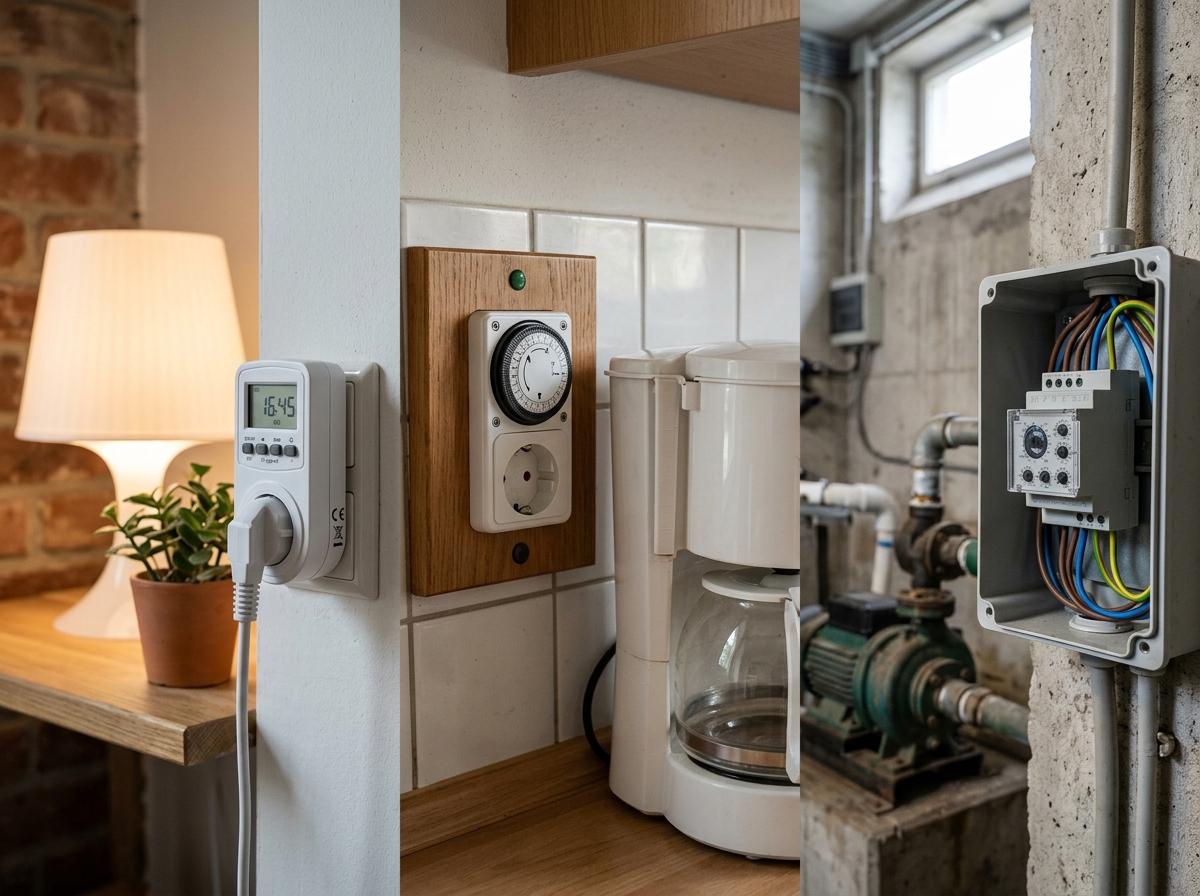 Digital Timer Switch Selection for Real European Applications
The correct timer depends on the load and environment, not simply on the number of programmable events.
For residential and light commercial lighting, buyers often prioritize a clear display, intuitive programming, manual override, memory retention, and a compact enclosure. For heating, pumps, motors, and other inductive equipment, the stated resistive load rating may not represent the safe operating limit. The supplier should explain the load category, inrush behavior, relay contact limits, and whether an external switching device is recommended.
Outdoor and industrial applications demand additional scrutiny. Moisture, dust, vibration, temperature changes, cable movement, and accidental impact can affect the enclosure and connection system. In these settings, a timer may be part of a wider power-control solution that includes industrial plugs and sockets, extension leads, cable reels, or cable-management accessories.
A practical procurement workflow should follow these steps:
- Define the electrical load, environment, installation method, and sales country.
- Request the model-specific technical and compliance documents before approving samples.
- Test the sample with the intended appliance or load, including power interruption and manual override behavior.
- Confirm artwork, language, labels, packaging, spare parts, and service responsibilities.
- Document the approval sample and require written authorization for later component or firmware changes.
Questions to Ask a European Timer Supplier During RFQ
A strong request for quotation makes suppliers comparable and exposes missing information early.
- What are the input voltage, frequency, output type, and maximum loads for resistive, motor, and lamp applications?
- What happens to programmed settings after a power failure, battery depletion, or reset?
- Which safety and EMC standards were used, and do the reports identify the quoted model?
- Are the plug, socket, terminal, enclosure, and cable options available for the target market?
- What inspection stages verify assembly, switching, display operation, insulation, and labeling?
- How are engineering changes, alternative components, and firmware revisions controlled?
- Can the supplier provide manuals, packaging artwork, private-label support, and technical files for the importer?
These questions also help distinguish an actual manufacturer from a trading company that cannot control the design or explain the test configuration.
OEM and ODM Capability: What to Verify Before Customization
Customization is reliable only when the supplier treats it as a controlled engineering project rather than a logo-printing service.
For private-label programs, define the ownership and approval process for drawings, molds, firmware, labels, packaging, and test documents. Confirm which changes trigger a new evaluation. A change from one relay supplier to another, for example, can affect contact behavior, switching life, EMC characteristics, and safety spacing.
Ask for a sample schedule that separates engineering samples, approval samples, and production samples. The approval record should include photographs, product markings, operating instructions, carton details, and the exact components used. This creates a reference point for incoming inspection and future claims.
Manufacturing automation can support consistency and volume, but equipment alone does not prove quality. Buyers should review inspection records, calibration practices, line testing, nonconformance handling, and batch traceability. A supplier with in-house research and testing capability may be better positioned to adapt the timer to a specific application, but that capability should still be demonstrated through documents and sample results.
Red Flags When Choosing a Digital Timer Switch Manufacturer
The most serious warning signs are vague technical claims, incomplete documents, and reluctance to test the actual application.
- The supplier provides a certificate without a model number or configuration.
- The quoted load rating does not distinguish resistive and inductive loads.
- The supplier cannot explain behavior after power interruption.
- Product photographs show different housings, plugs, or displays across the documentation.
- There is no written process for component changes or firmware revisions.
- Packaging and manuals are treated as an afterthought for a regulated market.
- The supplier promises compliance but refuses to identify the laboratory or applicable technical basis.
These issues do not automatically prove that a product is unsafe, but they increase the buyer’s verification burden and create avoidable risk during import, retail launch, or project acceptance.
A Practical Approval Scorecard for European Buyers
The final decision should balance technical risk, documentation quality, commercial reliability, and application fit.
Use a weighted internal scorecard if several suppliers appear technically similar. Give the greatest attention to non-negotiable requirements such as correct electrical rating, applicable compliance evidence, sample performance, and change control. Price should be assessed together with packaging work, testing, corrective-action support, spare parts, and the cost of replacing a nonconforming shipment.
For distributors, a supplier that can support several related categories may simplify product architecture. Digital and mechanical timers can address different user needs, while industrial plugs, extension leads, cable reels, and cable organizers can support a broader power-connection range. The portfolio is valuable when the supplier can preserve clear specifications across categories rather than using one generic description for every product.
FAQ
What is the first document to request from a timer switch manufacturer?
Request a model-specific specification sheet and declaration of conformity, followed by the applicable safety, EMC, and materials evidence. The documents should identify the exact model and configuration offered for sale.
Does a digital timer switch need EMC evaluation?
It may need EMC evaluation when it falls within the scope of the applicable European requirements. The risk is especially important when the timer uses electronic controls or switches inductive, motor, lighting, or other electrically noisy loads.
Can a resistive load rating be used for a motor?
Not automatically. Motors can create starting current and switching conditions that differ materially from a resistive heater or lamp. Ask the supplier for the motor or inductive-load limitation and any recommended external contactor or protection.
What should an importer check on a sample?
Check markings, instructions, programming, clock accuracy, manual override, power-loss behavior, terminal or plug construction, enclosure quality, and operation with the intended load. Record the approved sample so production units can be compared against it.
How should OEM timer changes be controlled?
Require written approval for changes to relays, power supplies, displays, firmware, housings, terminals, labels, and packaging. Ask the supplier to explain when a change requires renewed testing or updated documentation.
Is a factory audit necessary for every purchase?
The level of audit should reflect product risk, order scale, customization, and sales channel. At minimum, review manufacturing controls, inspection records, traceability, testing equipment, nonconformance procedures, and change management.
What makes a European timer supplier suitable for long-term cooperation?
Long-term suitability usually combines stable product specifications, responsive engineering, transparent compliance evidence, consistent production, export documentation, realistic lead-time communication, and structured after-sales support.
About the Manufacturer
Founded in 1986, Soyang Group develops electrical connection and control products for retail, industrial, outdoor, and engineering applications. Its portfolio includes digital and mechanical timers, plugs and sockets, extension leads, cable reels, and cable-management accessories. In-house development, testing capability, automated production, export experience, and OEM/ODM support help buyers evaluate both standard products and customized programs. Visit the product range or submit an inquiry through the company website to discuss application, documentation, and supply requirements.

Post time: Oct-13-2026