
- Verify the product’s intended electrical range, pole configuration, clock position, ingress protection, and cable compatibility.
- Separate documented compliance from vague claims about certification or export experience.
- Assess production control, testing, traceability, sampling, and batch consistency before placing a volume order.
- Compare the total procurement risk, including customization, packaging, logistics, technical support, and warranty handling.
CEE industrial plugs are selected successfully when electrical suitability, environmental protection, conformity evidence, and supply capability are reviewed together. The European Union Low Voltage Directive covers electrical equipment with rated voltage from 50 to 1,000 volts AC or from 75 to 1,500 volts DC; this regulatory scope is defined in the official Low Voltage Directive. This guide explains how importers, distributors, and engineering buyers can compare a CEE plug supplier without relying on price or marketing language alone.
What CEE industrial plugs are designed to do
CEE industrial plugs are purpose-built connectors for demanding power distribution rather than ordinary household convenience use. In European applications, buyers commonly evaluate connector families by rated current, voltage, number of poles, frequency, clock position, cable entry, environmental protection, and mechanical durability.
The correct connector is determined by the complete electrical and environmental system, not by the plug body alone. A factory maintenance team may prioritize frequent mating cycles and resistance to dust or moisture, while a construction distributor may need flexible cable compatibility, impact resistance, clear identification, and reliable stock availability.
Clock position is a practical selection detail because it helps prevent incompatible combinations when different voltage or frequency arrangements share a similar connector format. A supplier should therefore provide a clear product identification method rather than asking the customer to select by appearance.
How to compare an industrial plug manufacturer
The strongest comparison begins with documented technical control and ends with commercial execution. Use the following areas as a structured supplier audit.
1. Verify the technical specification
A credible manufacturer should be able to provide a complete technical data sheet for each selected configuration. Review the rated current, rated voltage, pole arrangement, frequency, clock position, protection rating, terminal design, cable range, operating environment, and applicable conformity information.
Do not accept a catalog image as technical evidence. Ask whether the published rating applies to the entire finished assembly, whether the cable gland is included, and whether the product has different limitations when used outdoors, under continuous load, or in an installation exposed to water, dust, chemicals, or impact.
2. Examine materials and construction
Material selection affects heat management, mechanical strength, chemical resistance, and service life. Compare the housing compound, contact material and plating, sealing components, strain relief, terminal access, and fastening method.
For mobile equipment, strain relief and cable retention deserve special attention because repeated pulling can transfer force to terminals. For outdoor or washdown locations, the enclosure design and sealing interfaces matter as much as the nominal protection claim.
3. Distinguish compliance from certification language
Compliance should be supported by identifiable documentation, not by a logo copied into a brochure. Request the declaration of conformity, applicable standards, test reports where appropriate, product identification, and the relationship between the document and the exact model being quoted.
The European Commission explains the role of CE marking and manufacturer responsibilities. A buyer should still confirm which legislation applies to the product, who is responsible for the technical file, and whether the supplied configuration matches the documented assessment.
Electrical safety also depends on installation and use. The United Kingdom Health and Safety Executive provides practical guidance on electricity at work and electrical equipment safety, including the need to control risks through suitable equipment, maintenance, and operating procedures.
4. Assess testing and production consistency
A factory with internal testing capability can identify defects earlier than a trading-only supplier, but the buyer should ask what is actually tested. Useful evidence may include incoming-material checks, dimensional inspection, contact resistance testing, dielectric or insulation testing, continuity checks, sealing verification, mechanical inspection, and final visual control.
Automation can improve repeatability, but equipment alone does not prove quality. Ask how test results are recorded, how nonconforming products are isolated, how corrective actions are closed, and whether production records can be traced to a batch or order.
5. Review development and customization capability
OEM and ODM projects require a defined engineering process. Compare the supplier’s ability to review drawings, confirm critical dimensions, develop tooling, approve samples, manage revisions, and protect confidential product information.
Customization should not be limited to changing a logo. It may involve housing color, label language, cable assembly, packaging, terminal configuration, strain relief, or a private-label document set. Each change should be recorded in an approved specification so that future orders do not drift from the validated sample.
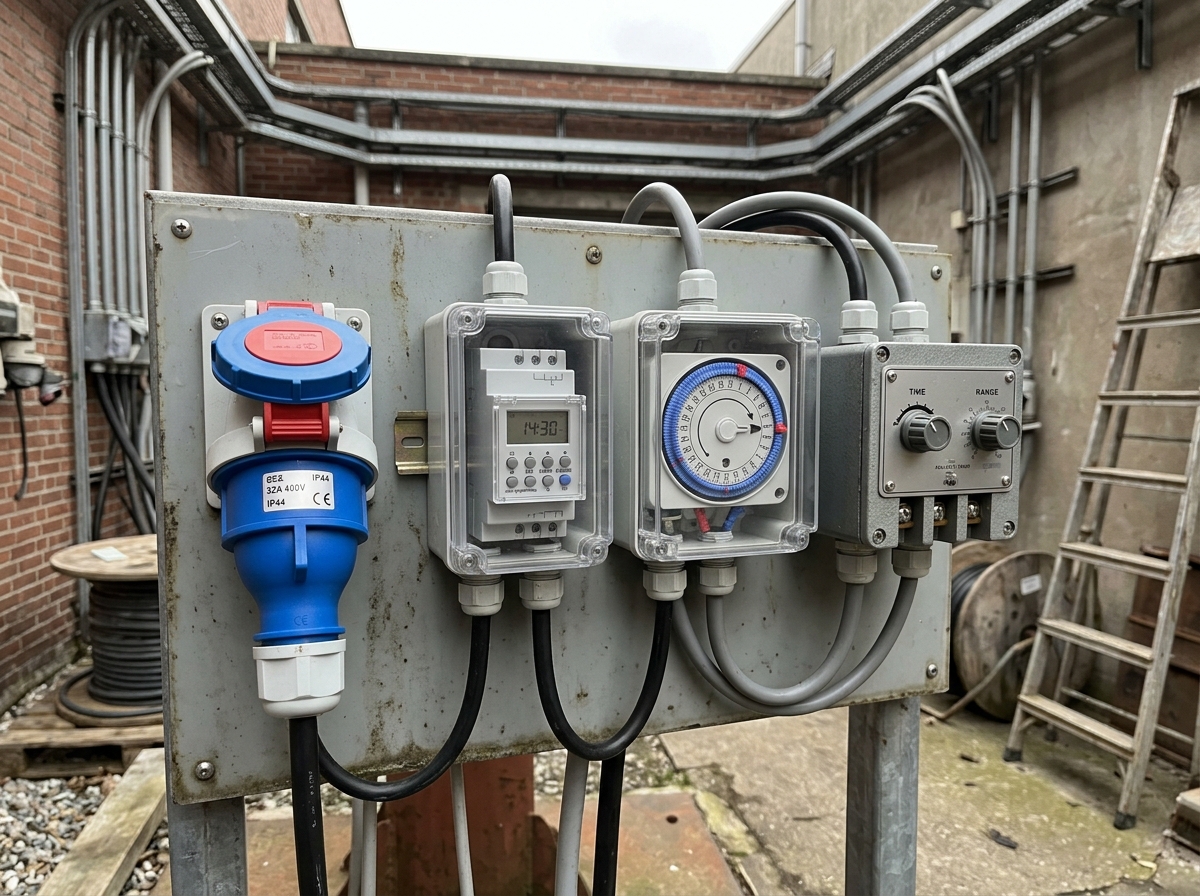 CEE plug supplier comparison scorecard
The following scorecard is an editorial purchasing framework, not an industry statistic. Assign a score from 1 to 5 for each area after reviewing evidence. A low score means that documentation or capability is incomplete; a high score means that the supplier provides specific, relevant, and repeatable evidence.
| Evaluation area | Suggested weighting | Evidence to request | Risk if ignored |
|---|---|---|---|
| Technical fit | 5 points | Model matrix, electrical ratings, pole and clock-position data | Incorrect or incompatible selection |
| Safety and conformity | 5 points | Declaration, applicable standards, test documentation | Market access or compliance problems |
| Environmental suitability | 4 points | Protection information, sealing details, material data | Moisture, dust, or impact failure |
| Manufacturing control | 4 points | Inspection plan, traceability, corrective-action process | Inconsistent batches |
| Customization | 3 points | Drawing review, sample approval, revision control | Uncontrolled design changes |
| Supply capability | 3 points | Capacity discussion, lead-time planning, packaging details | Stock disruption or delivery damage |
| Technical support | 3 points | Pre-sales response, installation guidance, complaint process | Slow resolution of field issues |
Weighting should reflect the application. A temporary outdoor power system may give environmental protection and cable handling greater importance, while a private-label distributor may emphasize documentation, packaging, repeatability, and product variation management.
Specification comparison for European electrical applications
A useful comparison table makes hidden differences visible before samples are ordered. The values in the table below are selection fields rather than assumed product specifications; the supplier must complete them for the exact model under review.
| Selection field | Question for the manufacturer | Why it matters | Buyer record |
|---|---|---|---|
| Rated current | Which current class is declared for the complete product? | Determines equipment compatibility and thermal suitability | Exact catalog value |
| Rated voltage | Which voltage range and frequency are covered? | Prevents use outside the documented electrical design | Exact catalog value |
| Pole arrangement | Does the model include the required protective conductor and neutral arrangement? | Supports correct system connection | Model confirmation |
| Clock position | Is the key position correct for the intended system? | Reduces mismatching risk | Model confirmation |
| Environmental protection | What protection claim applies to the assembled connector? | Relevant to dust, water, cleaning, and outdoor exposure | Document reference |
| Cable compatibility | Which cable outside diameters and conductor sizes are accepted? | Improves strain relief and installation reliability | Installation range |
| Identification | Are markings permanent, legible, and suitable for the destination market? | Supports safe installation and distribution | Artwork approval |
| Packaging | How are units protected, labeled, and packed for export? | Reduces transit damage and warehouse confusion | Packing specification |
Questions to ask before approving samples
Sample approval is most useful when it tests the purchase specification rather than simply confirming appearance. Ask the supplier to clarify the following points before issuing a purchase order.
- Which exact model number, drawing revision, and document revision apply to the quotation?
- What changes are permitted between the approved sample and mass production?
- Which tests are performed on every unit, and which are performed by sampling?
- How are material substitutions controlled if a component becomes unavailable?
- Can the supplier provide packaging artwork, language labels, and carton identification for the destination market?
- What information is required to investigate a field complaint, and how are replacement decisions made?
For a distributor, packaging and documentation can be as important as the connector itself. Retail-ready labeling, multilingual instructions, barcode control, and consistent carton quantities reduce receiving and resale friction. For an engineering buyer, drawings, cable data, installation instructions, and change notification may have greater value.
Common comparison mistakes
The most expensive mistake is selecting a low-price plug before confirming the complete application requirement. A lower quotation may exclude cable assembly, special packaging, testing documents, tooling, or engineering support.
Another common error is comparing protection claims without checking the test condition. The buyer should ask whether the stated protection applies to the complete mated connection, the plug alone, or a specific installation orientation.
A third error is treating export history as proof of suitability. Export experience is useful, but it should be supported by product identification, stable documentation, quality records, and a clear response process for nonconforming goods.
How to choose the right CEE plug supplier
The right supplier is the one that can connect technical evidence with dependable execution. Begin with the application, shortlist manufacturers that cover the required connector range, request current documents, compare samples against drawings, and complete a controlled pilot order before expanding volume.
- Define the electrical, mechanical, environmental, and market requirements.
- Request a model matrix and compliance documents for the exact configurations.
- Score technical control, materials, testing, customization, logistics, and support.
- Inspect samples and record any approved deviations.
- Confirm packaging, delivery planning, warranty handling, and change notification.
- Review the first production batch before establishing a long-term supply arrangement.
Manufacturers that combine product development, testing, automated production, export documentation, and OEM or ODM coordination may reduce communication gaps between design, quality, and delivery. Buyers should verify those capabilities through records and samples rather than relying on general claims.
FAQ
What should I check first when comparing CEE industrial plug manufacturers?
Start with the application and the exact electrical configuration. Confirm rated current, voltage, frequency, pole arrangement, clock position, cable compatibility, environmental exposure, and required documentation before comparing price.
Is a CE mark enough to approve a CEE plug supplier?
No. CE marking is part of a conformity process, but it does not replace technical review. Confirm the applicable legislation, declaration, product identification, supporting records, and suitability for the intended installation.
How can I compare a factory with a trading company?
Ask who controls the design, tooling, testing, materials, traceability, and corrective actions. A trading company may still be suitable, but the responsible manufacturer and evidence chain should be clearly identified.
What documents should an importer request?
Request a technical data sheet, product drawing, declaration of conformity where applicable, relevant test information, material details, installation guidance, packaging specification, and a controlled model or revision list.
Are customized CEE plugs suitable for private-label distribution?
They can be suitable when customization is controlled. Approve drawings and samples, define marking and packaging requirements, record revisions, and confirm that the customized configuration remains covered by the relevant technical documentation.
How should outdoor and construction applications be evaluated?
Review moisture, dust, impact, abrasion, temperature, cable flexibility, strain relief, cleaning methods, and storage conditions. Confirm that the complete assembled product is appropriate for the stated environment.
What is the best way to reduce supply risk?
Use a documented specification, approve a reference sample, establish inspection requirements, define change notification, review packaging, and begin with a controlled order. Keep technical and commercial records aligned for every repeat purchase.
About the manufacturer
Since 1986, Soyang Group has focused on electrical connection and control products, including timers, plugs and sockets, extension cables, cable reels, and cable-management accessories. Its product structure supports retail, industrial, outdoor, and engineering applications, with in-house development, testing, automated production, export experience, and OEM or ODM coordination. Buyers can review the product range and contact the team for application guidance, documentation, samples, or a sourcing discussion.

Post time: Sep-28-2026