
- IP44 describes ingress protection, not electrical load capacity or overall product quality.
- Match the CEE socket to the system voltage, current, poles, frequency, connector clock position, and installation method.
- Use IP44 for locations with splash exposure, while severe rain, standing water, dust, or washdown may require a higher protection level.
- Outdoor reliability depends on the complete installation, including plugs, cable glands, covers, distribution boxes, and protective devices.
Choosing an IP44 CEE socket for outdoor power distribution requires more than checking the IP marking. The International Electrotechnical Commission explains that the first digit in an IP code addresses solid-object protection and the second addresses water protection; in IP44, both digits are rated 4. This guide explains how to interpret that rating, select the electrical configuration, compare installation options, and avoid common mistakes in construction, events, agriculture, workshops, and temporary power systems.
What Does an IP44 CEE Socket Protect Against?
IP44 indicates protection against solid objects larger than 1 mm and splashing water from any direction, but it does not mean the socket is waterproof or suitable for immersion.
The first numeral, 4, is associated with protection against solid foreign objects above 1 mm. The second numeral, also 4, relates to water splashes. The IEC explanation of IP ratings should be used as the primary reference when comparing enclosure markings. IP testing applies to the product under defined test conditions; actual outdoor performance still depends on installation, aging, cable entry, covers, and mechanical damage.
An IP44 CEE socket is therefore a practical choice for sheltered outdoor distribution boards, covered work areas, temporary event infrastructure, and equipment positioned away from direct water jets. It may be unsuitable for exposed locations with driving rain, hose cleaning, flooding, condensation, or heavy dust. In those conditions, review the complete assembly and consider a higher IP level.
How to Match a CEE Industrial Socket to the Electrical System
The correct CEE industrial socket must match the supply system and the connected equipment in every material electrical parameter.
Current and voltage
Current and voltage ratings are selection requirements, not performance claims that can be inferred from the IP code. A socket marked for a particular current must be paired with conductors, protective devices, plugs, and distribution equipment designed for the same application. Never select a socket only because its body looks robust.
Before ordering, record the supply voltage, phase arrangement, rated current, frequency, number of poles, and earthing arrangement. In European industrial applications, CEE connectors are commonly identified by color, electrical rating, and clock position, but the exact configuration must be confirmed against the local system and equipment documentation.
Poles and clock position
Pole count and clock position prevent many connection errors. A connector may include line, neutral, and protective-earth contacts, while other systems use a different arrangement. The clock position helps distinguish connectors with similar current and voltage markings. The plug and socket must have the same compatible configuration; an adapter should not be used to bypass an incompatible earthing or voltage arrangement.
Cable entry and strain relief
Cable entry is a major factor in outdoor reliability because a well-rated enclosure can lose practical protection through a poorly sealed gland or incorrectly terminated cable.
- Check the permitted cable outside diameter before selecting the gland.
- Use strain relief so pulling force is not transferred to the terminals.
- Keep the cable bend radius within the cable maker’s instructions.
- Inspect seals for compression, cuts, hardening, and contamination during maintenance.
For mobile construction equipment, an industrial extension lead or cable reel should be selected as part of the same system. The socket rating, cable cross-section, plug configuration, reel thermal behavior, and protective device must be evaluated together.
IP44 CEE Socket Selection by Outdoor Use Case
The best socket depends on how water, dust, impact, movement, and access will affect the installation.
| Application | Primary exposure | IP44 suitability | Selection checks |
|---|---|---|---|
| Covered construction area | Occasional splash, impact, cable movement | Often suitable when the assembly is sheltered | Impact resistance, strain relief, current rating, RCD protection |
| Outdoor event distribution | Rain, frequent connection changes, public access | May be suitable only with additional weather protection | Locking covers, cable routing, mechanical protection, inspection access |
| Workshop entrance | Dust, splash, repeated plugging | Suitable only when cleaning and water exposure are limited | Enclosure placement, cover condition, connector wear |
| Washdown or exposed rain area | Direct water, hose spray, standing moisture | Usually insufficient without further enclosure measures | Higher IP requirement, drainage, sealing, local electrical rules |
| Agricultural or utility site | Moisture, dirt, chemicals, impact | Requires site-specific assessment | Material compatibility, corrosion resistance, cleaning method |
Outdoor power distribution should be planned around the worst credible exposure, not the average weather on the installation day. The United Kingdom’s Health and Safety Executive electrical safety guidance emphasizes risk control around electrical equipment, work conditions, and inspection. The United States Occupational Safety and Health Administration also provides electrical safety resources covering workplace electrical hazards and safe practices.
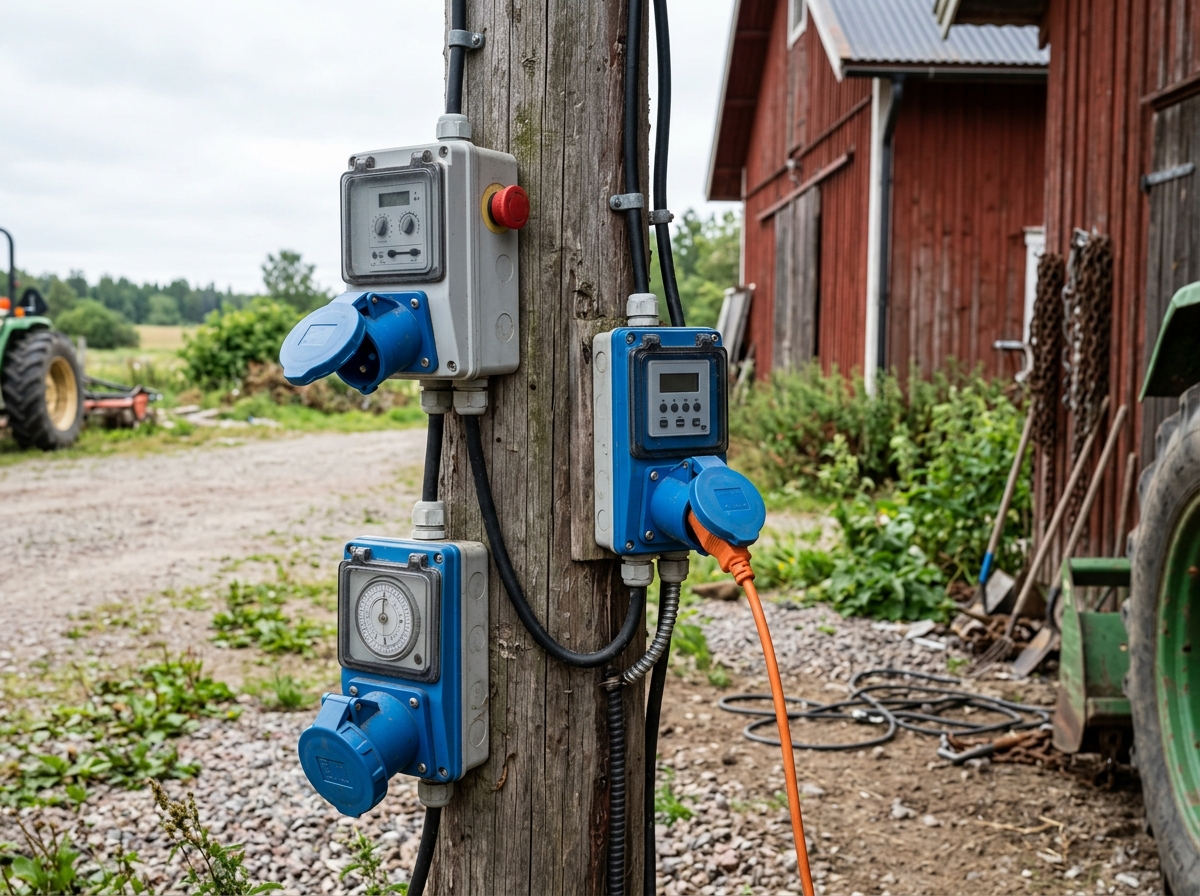 Comparing Socket Installation Options
Fixed, surface-mounted, panel-mounted, and portable CEE sockets solve different distribution problems.
| Installation type | Best use | Main advantage | Main risk to control |
|---|---|---|---|
| Surface-mounted socket | Walls, temporary boards, equipment frames | Accessible installation and straightforward replacement | Mounting damage, exposed cable entry, loose fixings |
| Panel-mounted socket | Distribution cabinets and machine panels | Compact integration with a protected enclosure | Incorrect cutout, inadequate gasket compression, terminal access |
| Portable socket box | Temporary work zones and event power | Flexible positioning and fast deployment | Dragging, impact, unstable placement, cable trip hazards |
| Switched socket | Equipment requiring local isolation | Visible local control before connection or disconnection | Switch rating and isolation procedure must match the load |
A socket that is technically appropriate can still fail in service if it is mounted where water collects or where vehicles and tools can strike it. Place connectors above likely splash and flood paths when the site design permits, protect cables from crushing, and provide enough clearance for safe plugging and unplugging.
Safety Checks Before Buying an Outdoor Power Socket
A short purchasing checklist prevents most avoidable mismatches between a CEE connector and the installation.
- Identify the supply voltage, current, phase, frequency, poles, and clock position.
- Define the environment: sheltered, exposed, dusty, wet, corrosive, mobile, or washdown.
- Confirm the required IP rating for the complete assembly, not only the socket body.
- Check cable diameter, terminal capacity, gland compatibility, and strain-relief design.
- Review the applicable national installation rules and the equipment manufacturer’s instructions.
- Confirm whether the socket needs a switch, interlock, locking cover, or mechanical guard.
- Request technical drawings, material information, test documentation, and traceable product identification from the supplier.
Electrical protection must be designed at system level. A socket does not replace overcurrent protection, effective earthing, residual-current protection where required, or inspection by a qualified person. The National Fire Protection Association electrical safety resources provide additional context for electrical hazard prevention and safe work practices.
Common IP44 CEE Socket Selection Mistakes
The most common mistake is treating IP44 as a complete outdoor approval.
Mistake 1: Choosing by appearance
A heavy-looking housing does not prove the correct electrical rating, sealing performance, material compatibility, or terminal capacity. Request the technical data sheet and installation instructions.
Mistake 2: Ignoring the plug-to-socket system
The socket must be compatible with the plug, cable, supply, and equipment. A correct-looking current rating cannot compensate for the wrong voltage or pole arrangement.
Mistake 3: Overlooking the cable reel
A reeled cable can behave differently from a fully unwound cable because heat dissipation and operating conditions change. Follow the reel manufacturer’s instructions and do not assume the socket rating determines the permissible cable load.
Mistake 4: Installing without a maintenance plan
Outdoor connectors need periodic inspection for cracked covers, damaged seals, discoloration, loose terminals, corrosion, and contamination. Replace damaged components rather than relying on tape or improvised covers.
How to Specify an IP44 CEE Industrial Socket for OEM Supply
OEM buyers should provide an application brief rather than requesting a generic outdoor socket.
Include the target market, electrical configuration, installation type, cable range, housing material, color requirements, branding, packaging, documentation, test expectations, and forecast volume. Ask the manufacturer to confirm which characteristics are standard and which require engineering review. For a product intended for export, request applicable compliance documentation and product traceability before approving samples.
A manufacturer with in-house development and testing capability can help resolve interface questions earlier, especially when the socket is part of a wider system containing industrial plugs, extension leads, cable reels, timers, or distribution accessories. The practical objective is a repeatable product specification that purchasing, quality, installation, and service teams can all interpret consistently.
FAQ
Is an IP44 CEE socket waterproof?
No. IP44 provides protection against solid objects larger than 1 mm and splashing water, but it does not indicate protection against immersion, powerful water jets, or every form of severe weather exposure.
Can I use an IP44 CEE socket in direct rain?
It may be used only when the complete installation and the manufacturer’s instructions permit the exposure. Direct rain, wind-driven water, pooling, and repeated wetting may require additional shelter or a higher IP rating.
What should I check besides the IP rating?
Check current, voltage, frequency, phase, pole count, clock position, earthing arrangement, cable compatibility, mounting type, operating temperature, impact exposure, and the required protective devices.
Is IP44 suitable for a construction site?
It can be suitable in a sheltered and properly protected temporary distribution system. Construction sites also require attention to mechanical damage, cable routing, inspection, residual-current protection, and local electrical rules.
Does a higher IP rating always mean a better socket?
No. A higher rating may be unnecessary for a dry, sheltered installation and does not automatically confirm the correct electrical capacity, impact resistance, chemical compatibility, or ease of maintenance.
Should the plug and socket have the same IP rating?
The connected components should be selected as a compatible system for the actual environment. The lower practical protection level, exposed connection point, cable entry, and enclosure design can determine the real installation risk.
What documents should an OEM buyer request?
Request a technical data sheet, dimensional drawing, wiring or terminal information, material details, installation instructions, applicable compliance documents, packaging specifications, sample records, and quality or test documentation relevant to the order.
About the Manufacturer
Soyang Group is an electrical accessories manufacturer with experience in timers, industrial plugs and sockets, extension leads, cable reels, and cable-management products. Its capabilities include product development, testing, automated production, export-oriented documentation, and OEM or ODM support. Buyers can evaluate the socket together with compatible power-distribution and cable-management components to create a more consistent outdoor supply system. Contact the company for application review, samples, and a project-specific quotation.

Post time: Sep-24-2026