
- Compare the switching function with the real load, not only the advertised maximum rating.
- Check programming usability, memory behavior, manual override, and power-failure recovery.
- Match the enclosure and protection level to indoor, workshop, commercial, or outdoor conditions.
- Request traceable compliance documents and product-specific test information before bulk purchasing.
- Evaluate packaging, customization, sampling, and after-sales support as part of total product suitability.
Choosing a digital timer switch for the European market requires more than comparing display size or price. The Low Voltage Directive covers electrical equipment rated between 50 and 1,000 volts AC or between 75 and 1,500 volts DC, so buyers should connect product selection with the intended supply and compliance route. This guide explains the timer switch features that matter in retail, commercial, and industrial purchasing.
What Should European Buyers Compare in a Digital Timer Switch?
The most important comparison is whether the timer can control the intended electrical load safely and predictably under actual operating conditions. A programmable timer used for lamps, heaters, pumps, signage, ventilation, or charging equipment may face different inrush currents, switching cycles, ambient temperatures, and installation constraints.
Start with the product’s electrical identity. Confirm the rated voltage, frequency, current, load category, switching method, terminal arrangement, plug format, and installation type. A timer intended for a household socket is not automatically suitable for a fixed installation or an inductive motor load.
| Comparison area | What to verify | Why it matters |
|---|---|---|
| Supply rating | Rated voltage, frequency, and current | Prevents use outside the product’s declared operating conditions |
| Load type | Resistive, inductive, capacitive, LED, or motor load | Switching behavior can vary with inrush current and power factor |
| Control method | Relay output, electronic switching, or external contactor control | Determines compatibility with the connected equipment |
| Installation | Socket, wall, panel, DIN rail, or portable format | Matches the timer to the physical application |
| Operating environment | Indoor, dusty, damp, exposed, or industrial location | Influences enclosure, protection, and maintenance requirements |
For products placed on the European market, documentation should be specific to the model and intended use. The EU Low Voltage Directive text explains the scope of electrical equipment within its stated voltage limits. Buyers should still ask the supplier which legislation, harmonized standards, technical files, declarations, and test reports apply to the exact product.
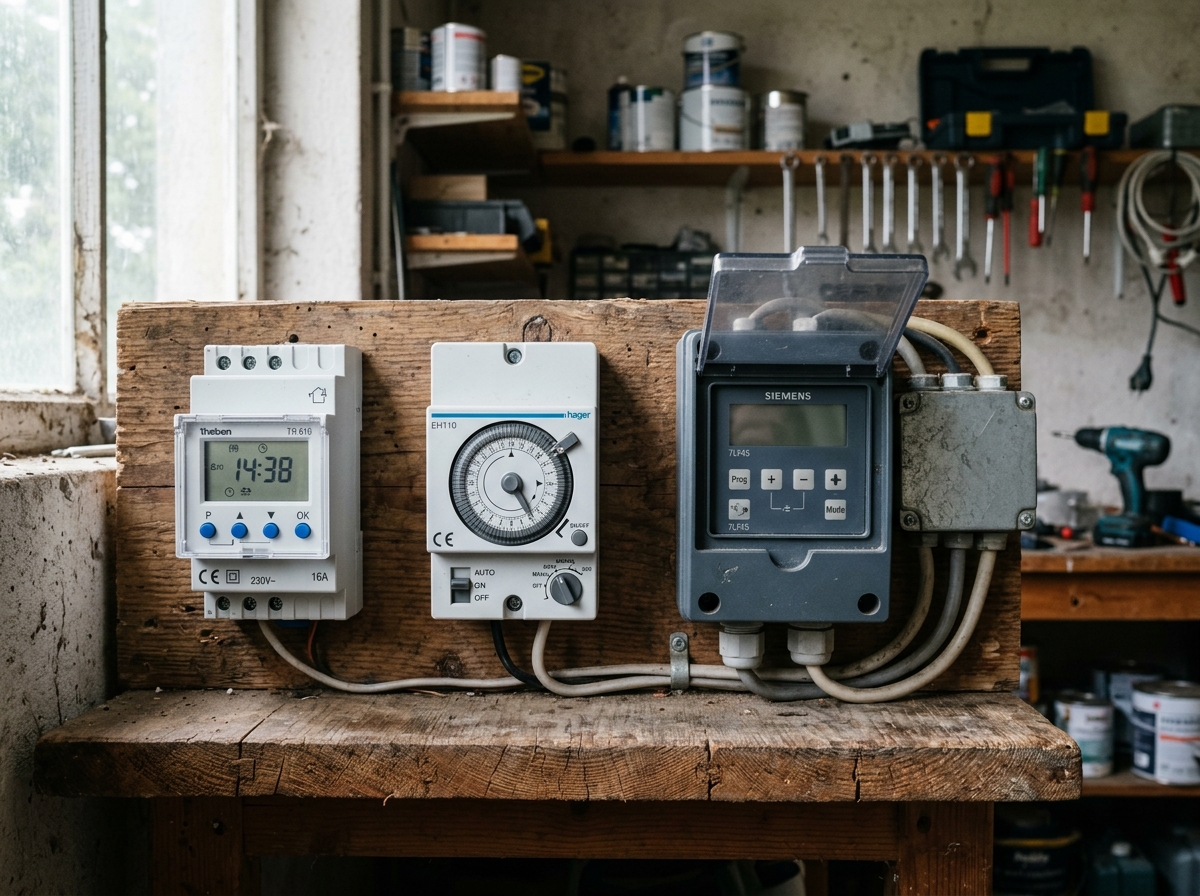 Programmable Timer Functions That Affect Daily Use
Programming flexibility is valuable only when users can configure the schedule without confusion or repeated correction. A buyer should compare the number and type of available programs, weekday selection, repeat behavior, minimum switching interval, daylight-saving handling, and manual override.
A clear display and tactile controls are especially important when the timer will be installed by retailers, facilities teams, or homeowners who do not use the device every day. A technically capable timer can still create support costs if the menu structure is difficult to understand.
- Check whether schedules can be repeated on selected days rather than only every day.
- Confirm whether the timer preserves settings after a power interruption.
- Verify whether manual on, manual off, and automatic modes are clearly separated.
- Ask whether the clock remains accurate under normal supply conditions and whether seasonal time changes require manual adjustment.
- Review the language, symbols, instruction quality, and reset procedure for the target market.
Battery backup is another practical feature, but its function must be defined. Some products use backup power only to preserve the clock and programs, while others may continue switching during an interruption. These are different purchasing requirements and should not be treated as equivalent.
Timer Switch Features for Different Electrical Loads
The correct load category is more important than a large headline current figure. Resistive loads such as some heating elements generally present a different switching challenge from motors, transformers, compressors, pumps, and LED drivers.
Inrush current can briefly exceed the steady operating current, placing stress on relay contacts or electronic switching components. For demanding loads, the preferred arrangement may be a timer controlling a suitably rated contactor rather than switching the equipment directly. This decision should be made from the equipment data and the timer manufacturer’s declared limits.
| Application | Typical operating concern | Selection question | Useful verification evidence |
|---|---|---|---|
| Lighting | LED driver inrush and frequent switching | Is the switching device rated for the complete lighting load? | Load-category data and test information |
| Heating | Continuous current and thermal conditions | Can the timer operate within its temperature and current limits? | Rated load and installation instructions |
| Pumps and motors | Starting current and inductive switching | Is direct switching allowed, or is a contactor required? | Motor-load guidance and wiring diagram |
| Commercial signage | Scheduled operation and frequent maintenance access | Can staff override the schedule without deleting it? | User manual and functional sample test |
| Charging equipment | Extended operation and thermal management | Does the timer suit the charger and connected equipment? | Application-specific compatibility review |
Never infer suitability from a socket shape alone. The plug or outlet format identifies mechanical compatibility, while the electrical rating, contact design, thermal behavior, and installation conditions determine whether the complete combination is appropriate.
Safety, Protection, and European Compliance
Compliance evidence should be reviewed as a product-specific purchasing document rather than treated as a logo on packaging. Ask for the declaration of conformity, applicable standards, technical specifications, labeling details, and instructions in the languages required for the intended sales markets.
Material restrictions may also affect import and distribution decisions. The European Commission RoHS Directive page describes restrictions on certain hazardous substances in electrical and electronic equipment. The buyer should confirm how the supplied model is covered and which supporting declaration or supplier information is available.
Ingress protection should be matched to the environment instead of selected as a marketing upgrade. The International Electrotechnical Commission explanation of IP ratings describes the code structure used to indicate protection against solid objects and water. An IP code does not by itself prove suitability for every outdoor, washdown, chemical, ultraviolet, or mechanical condition.
| Protection code element | Available code range | What the buyer should ask |
|---|---|---|
| First characteristic digit | 0 to 6 | What level of protection against solid foreign objects is declared? |
| Second characteristic digit | 0 to 9 | What water exposure is covered by the declared rating? |
| Unspecified characteristic | X | Which protection characteristic has not been rated or stated? |
The table uses the coding structure described by the IEC source. Buyers should request the actual test basis and product marking, because the code must correspond to the finished enclosure and its intended installation configuration.
Choosing Between Digital and Mechanical Timer Switches
A digital timer is usually preferable when the schedule is complex, repeatability matters, or users need a precise programmable interface. A mechanical timer can be preferable when the application is simple, the user values immediate visual adjustment, and the environment favors a straightforward control method.
Digital products can offer more scheduling logic, but they may have a steeper learning curve and greater dependence on electronic components. Mechanical products are often easier to understand at a glance, yet their resolution and scheduling flexibility may be more limited. The right choice depends on the operating task rather than the apparent sophistication of the product.
- Choose digital control for recurring schedules, selected-day operation, and frequent program changes.
- Choose mechanical control for simple repeating routines where rapid visual adjustment is the priority.
- Consider a higher-level control system when several circuits must be coordinated or monitored.
- Use an external switching device when the connected load exceeds the timer’s direct switching capability.
How to Evaluate a Supplier Before Bulk Purchase
Supplier evaluation should combine product engineering, testing, production control, and export support. A factory that can provide samples, drawings, packaging details, inspection records, and change-control information reduces uncertainty during approval.
The manufacturer behind the product range describes capabilities covering timers, plugs and sockets, extension leads, cable reels, and related electrical accessories. Its stated product structure supports a purchasing conversation around connected product families rather than an isolated timer item. Buyers should verify current model specifications, available certifications, and production terms directly before placing an order.
For an OEM or private-label project, define the approval path before tooling or packaging work begins. The buyer should agree on electrical specifications, target markets, marking, instruction languages, packaging, sample approval, inspection criteria, spare parts, and the process for handling engineering changes.
A Practical Digital Timer Switch Buying Checklist
A written checklist makes supplier comparisons more reliable because every candidate is assessed against the same requirements.
- Define the application, connected equipment, operating schedule, and installation location.
- Record the supply and load requirements from the equipment nameplate or technical file.
- Compare programming functions, display readability, override controls, backup behavior, and reset logic.
- Request model-specific safety, compliance, material, and test documentation.
- Examine the plug, socket, terminals, enclosure, cable entry, strain relief, and mounting method.
- Test a production-representative sample under the intended schedule and connected load.
- Confirm packaging, labeling, shipping documents, inspection arrangements, warranty handling, and replacement policy.
The best purchasing decision is the one that combines technical suitability with repeatable supply. A lower unit price does not compensate for unclear load limits, incomplete documentation, difficult programming, or avoidable field returns.
FAQ
What is the main advantage of a digital timer switch?
The main advantage is flexible automatic scheduling. Digital control is useful when the user needs selected-day programs, repeated switching routines, manual override, or a more precise schedule than a basic mechanical timer can provide.
Can a programmable timer control a motor or pump?
It may be possible, but the answer depends on the motor’s starting current, inductive load, switching frequency, and the timer’s declared load limits. A contactor may be required when direct switching is not permitted.
What documents should European buyers request?
Request the model specification, user instructions, declaration of conformity where applicable, relevant test information, material declarations, labeling details, and packaging information for the intended market.
Does an IP rating make every timer suitable for outdoor use?
No. An IP rating addresses defined protection characteristics, but outdoor suitability also depends on temperature, ultraviolet exposure, condensation, impact, chemicals, installation orientation, and cable-entry details.
How should buyers compare digital and mechanical timers?
Compare the task, not only the feature list. Digital models suit complex or frequently changed schedules, while mechanical models suit simple routines where immediate adjustment and basic operation are more important.
What should be tested before a large order?
Test programming, power-failure recovery, manual override, switching behavior, display readability, enclosure fit, plug compatibility, thermal behavior, and operation with the intended load or switching device.
Can a timer manufacturer support OEM or private-label projects?
Ask whether the supplier has in-house development, testing, sampling, packaging customization, documentation support, production inspection, and change-control procedures. These capabilities are more important than a generic claim of customization.
About the Manufacturer
Established in 1986, Zhejiang Shuangyang Group develops electrical connection and control products for retail, industrial, and project applications. Its portfolio includes digital and mechanical timers, plugs and sockets, extension leads, industrial accessories, cable reels, and cable-management products. In-house development, testing capability, automated production, export experience, and OEM or ODM support can help buyers coordinate product specifications, packaging, and delivery. Review the product range or submit an inquiry after confirming the model requirements.

Post time: Oct-08-2026