
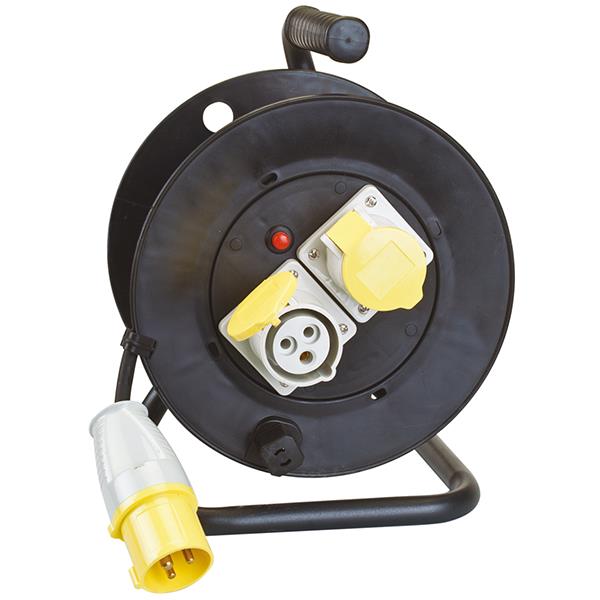
The reel is four bought-in parts and a screwdriver, so it is the easiest product in the category to fake manufacturing depth on.
TL;DR — evaluating a cable reel supplier, in five points
- A cable reel is the easiest product in the category to present as manufactured. It is a drum, a socket-outlet, a plug and a cable, and if you buy those four from other factories then assembly is the whole of the manufacturing operation.
- Ask for the production flow chart. Ours runs winching → extrusion → hanging → riveting → plug injection → assembling → testing → packaging → warehousing. A trading company has sourcing, quality inspection and packing, and the flow is the one artefact a website cannot fake.
- Ask who owns the tooling for the drum, the socket and the plug, and what a new-tool lead time is. Tooling ownership is the difference between a product you can iterate and a product you re-order.
- Look for the derated rating. A manufacturer publishes the power fully reeled and unreeled separately and qualifies the cable length by cable type. A single headline wattage is the trading company signature.
- Check the certificate against the exact model number and the variant list, because a reel family spans ratings from 660 W to 3600 W and the variants are not interchangeable.
The short answer for a buyer qualifying a cable reel supplier: a cable reel is a mechanical assembly of four bought-in parts — the drum, the socket-outlet, the plug and the cable — which makes it the easiest product in the electrical accessories category for a trading company to present as manufactured, and it makes the evaluation an exercise in asking for artefacts rather than for claims. Ten checks, and three of them settle the question in a single exchange.
We have been making cable reels, cords, plugs, sockets and timers in Cixi, Ningbo since 1986, and this is the evaluation we would run on any supplier in the category — including the questions we would have to answer ourselves. Our industrial cable reel page is the reference product, the CE GS ROHS European cable reel is the outdoor version, and the plugs and sockets product page is the upstream part that most buyers do not think to check.
Why a Cable Reel Is the Hardest Product to Vet
Look at what a reel physically is: a drum, a socket-outlet, a 2-II plug, and a length of cable. Four bought-in parts, and a bench on which to put them together. There is no metallurgy in it, no proprietary process and no hard-to-copy tooling — the socket and the plug are standard catalogue items from a handful of European and Chinese factories, the cable is a standard extrusion, and the drum is a moulded or stamped shell.
Which means the category attracts both genuine manufacturers and assemblers, and both can present an identical website. Because the assembly step is the whole of the visible operation, the difference between the two sits in the parts you are not shown — and it has to be extracted by asking.
Three questions settle it in one exchange: can you show your production flow for this reel, who owns the mould for the socket, and which certificate covers this exact model number — and can I have it before the order?
For scale, our own position on that question is a floor area of about 120,000 square metres with a further 85,000 square metres under construction, more than 500 employees, over 100 quality control staff and a ten-person R&D team, an ISO 9001, ISO 14001 and OHSAS 18001 management system, and a turnover of around US$80 million in 2018 on registered capital of more than US$16 million. None of those numbers proves that we manufacture rather than assemble, and a buyer should treat them the way the rest of this article treats any claim: as something to verify against the production flow, the tool list and the certificate. They are published because a supplier who will not publish numbers is telling you something.
There is one more thing worth saying at the outset, because it is fair rather than accusatory. Plenty of good manufacturers also sell to trading companies, and a supplier that is open about that is telling you something true. The question is not who they sell to, it is what happens to your order inside the factory — whether your specification, your branding and your test requirements are handled as a defined version of the product, or whether your units are folded into a standard production run.
The Ten Checks
1. Who extrudes the cable?
Start at the most upstream part. Ask whether the cable is extruded in house and whether the reel ships with the supplier’s own cable or with cable you nominate, then check the cable type against the length. On the reference reel the maximum length is qualified by the cable: 1.0 mm² H05RR-F or H05RN-F runs up to 40 metres, while 2.5 mm² H07RN-F is qualified to 20 metres. A supplier who quotes one maximum length for every cable type is quoting the brochure.
2. Who injection-moulds the plug and the socket?
Request the tool list and the press tonnage range. This is the check that decides whether your brand can go moulded into the plug, and whether the reel can carry a proprietary connector. A supplier that buys its plugs in cannot do either, however good the product photography is.
3. Who winds the reel and who assembles it?
This is where the reel becomes a reel. Ask about the winding setup, the tension and the length control, because a reel wound unevenly will not sit flat on a bench, and about who fits the socket-outlets, the plug and the frame. Nobody can show you a winding process they bought from a supplier, and the question is the cheapest possible way to find out.
4. Who owns the tooling?
Ask who owns the moulds for the drum, the socket and the plug, what the new-tool lead time is, and whether a new colour can be run on an existing tool. Tooling ownership is the difference between a product you can iterate and a product you re-order, and it is also what lets a supplier quote a price that falls with volume instead of one that does not.
5. Can you show the production flow?
This is the artefact that cannot be faked. Our published flow for a cable reel runs from winching of the cables and reels, through extrusion, hanging, riveting and plug injection, to assembling, testing, packaging and warehousing — and every one of those is a process we run rather than a purchase. A trading company has sourcing, quality inspection and packing, and when you ask for a flow chart, the shape of the answer is the answer.
6. What is tested, and is it 100 percent?
Ask for the test plan, and then ask for a report from a production lot rather than a type test. The tests that matter on a reel are the dielectric withstand and insulation resistance on the cord, the continuity of the protective conductor, the functional test of the thermal cut-out, the mechanical test of the socket lid and the strain relief, and the ingress protection test. A supplier that answers with a type certificate and no lot report is selling somebody else’s certificate.
7. Does the certificate cover the model you are buying?
Confirm that the model number on the declaration of conformity and on the GS or VDE documentation is the model on your purchase order, and that the listed variants cover your rating, your voltage and your cable. The framework is IEC 60309-1 for the industrial plug, the socket and the reel, the EU Low Voltage Directive, the EMC Directive and the RoHS Directive for the declaration, and for the United States a listed product installed to the National Electrical Code.
8. Does the published data include the derating?
Look for two numbers where a trader prints one. On the reference reel the maximum rated power is stated separately for the fully reeled and the unreeled state — 1000 W against 2300 W for 1.0 mm² cable, and 1200 W against 3600 W for 2.5 mm² — because a full drum traps heat and the copper sits at the top of the drum where the cooling is worst. A supplier who publishes only the higher figure is publishing the number the end user will never see.
9. What is the route to a design change?
Ask how long a variant takes, what it costs and whether it needs a new tool. A manufacturer answers with a route — our outdoor reel is available in a Germany version, a France version and a Denmark version on the same body, with the cable length and the packing set to your requirement — and with a tool lead time. A trading company answers with a minimum order quantity.
10. What does the commercial structure reveal?
A manufacturer quotes tooling separately, shows the unit price falling with volume, offers a sample fee that is refundable against the order, and states the delivery term and the payment terms plainly. A trading company quotes one blended price that does not move much, because the margin is the product. That behavioural difference tells you what you are buying before the first unit arrives.
The Scorecard
Put the two suppliers side by side on this table before you put them side by side on price.
| Criterion | A manufacturer can show | A trading company usually cannot |
|---|---|---|
| Production flow | Winching, extrusion, riveting, plug injection, assembly, testing, packing | Sourcing, quality inspection, packing |
| Tooling | Tool list, tool ownership, new-tool lead time | A statement that tooling is available on request |
| Cable | Extruded in house, type and maximum length qualified per cable | Cable sourced, one length quoted for all types |
| Plug and socket | Injection-moulded, mould list, custom plug possible | Purchased, catalogue only |
| Rating data | Fully reeled and unreeled power, thermal cut-out, cable limits | A single headline wattage |
| Testing | Test plan plus a production lot report, 100 percent tested | A type certificate and a statement |
| Certificates | Model-specific, with the variant list and the directive list | A group certificate and a marketing list of marks |
| Capacity | Monthly output and the real lead time by configuration | A capacity number and a negotiated lead time |
| Design change | A route from an existing body to a country variant, with cost and time | A minimum order quantity |
| Commercials | Tooling quoted separately, volume curve, refundable sample fee | One blended price that does not move |
What a manufacturer can tell you about a reel, published in full
Configuration CEE reel with two-way 2-I industrial socket outlets, self-closing spring lids, a 2-II industrial plug, non-rewirable, class 1, with a thermal cut-out in the side of the faceplate.
Ratings 230 V AC 50 Hz, IP44, 1000 W fully reeled and 2300 W unreeled at 1.0 mm²; 1200 W and 3600 W at 2.5 mm²; 110 V AC 16 A 4H variant at 660 W and 1760 W.
Mechanical drum outer diameter φ235 mm and φ280 mm depending on model, in plastic or metal.
Logistics 1 piece per colour box, 2 pieces per outer carton, carton 42 × 27 × 34 cm or 44 × 31.5 × 44 cm, 50,000 pieces per month, 30 to 45 days after deposit.
Approvals S, NF, GS, CE, RoHS, REACH and PAHS, with GS handled through the German VDE global service.
Eight Questions to Put in the Enquiry
Send these eight and the answers will do most of the evaluation for you.
- Can you send your production flow chart for this reel, and which steps run in your own factory?
- Who owns the moulds for the drum, the socket and the plug, and what is the new-tool lead time?
- Is the cable extruded in house, and what is the maximum length for each cable type and cross-section?
- Can you send the certificate and the declaration of conformity for my exact model number, with the variant list?
- What is the maximum rated power fully reeled and unreeled, for the cable and cross-section I need?
- What is the test plan, do you test 100 percent of production, and can you send a production lot report?
- What does a country variant or a custom length cost and how long does it take?
- What is the tooling cost, the sample policy, the monthly capacity and the delivery term?
Frequently Asked Questions About Cable Reel Suppliers
1. How do I tell a cable reel manufacturer from a trading company?
Ask for three artefacts rather than a claim. The production flow, which a manufacturer can draw from winching and extrusion through plug injection and assembly to testing and warehousing; the tool list, which shows who owns the moulds for the drum, the socket and the plug; and the certificate for the exact model number you are buying. A trading company can write a convincing website, but it cannot produce a flow that includes an extrusion line it does not own, nor a mould record for a tool it does not hold.
2. What should I ask about the cable on a cable reel?
Ask who extrudes it, and whether the reel is supplied with the reel’s own cable or with customer-supplied cable. Then check the cable type against the length, because the maximum length is qualified by the cable: a 1.0 mm² H05RR-F or H05RN-F runs up to 40 metres on the reference reel, while 2.5 mm² H07RN-F is qualified to 20 metres. A supplier who quotes one maximum length for every cable type is quoting the marketing, not the product.
3. Why do cable reel specifications show two different power ratings?
Because a full drum of cable traps heat and the copper is at the top of the drum where the cooling is worst, so the rating is lower with the cable reeled on. On the reference reel the maximum rated power is 1000 W fully reeled against 2300 W unreeled for 1.0 mm² cable, and 1200 W against 3600 W for 2.5 mm². A supplier who publishes only the higher figure is publishing the unreeled number, which is the number the end user will never see.
4. What does it mean that the reel has a thermal cut-out?
It means the faceplate carries a thermal cut-out in the side of it, so if the drum overheats — which happens when a reel is fully wound and running at the unreeled power figure — the supply to the socket is cut before the insulation in the cable degrades. It is a protection feature, it is a manufacturing detail, and it is the kind of detail that appears in the specification of a factory that builds the reel and disappears from the specification of one that assembles it.
5. Does a CE and GS certificate cover the reel I am ordering?
Only if the model number on the document is the model number on your purchase order, and only for the variants the document lists. This matters because a reel family covers a wide spread of ratings and configurations, and a 16 A 4H yellow reel at 660 W fully reeled, a 230 V IP44 reel at 1200 W and a 2.5 mm² version at 3600 W are not the same product. The regulatory framework for the plug, the socket and the reel itself is IEC 60309-1, and the product must also satisfy the EU Low Voltage Directive, the EMC Directive and the RoHS Directive, which the declaration of conformity should name one by one.
6. How do I check whether a supplier is testing before shipment?
Ask for the test plan and for a report from a production lot rather than a type test. The tests that matter on a reel are the dielectric withstand and insulation resistance on the cord, the continuity of the protective conductor, the functional test of the thermal cut-out, the mechanical test of the socket lid and the strain relief, and the ingress protection test. A supplier that answers with 100 percent of products tested before delivery and then sends a lot report is a manufacturer with a test bench; a supplier that answers with a type certificate and no report is selling someone else’s certificate.
7. Does it matter that the supplier also sells to traders?
Not in itself, and it is a fair question to put to a manufacturer. A factory that sells both to brands and to trading companies is a normal business model, and the relevant question is what happens to your order inside the factory: whether your specification, your branding and your test requirements are handled as a defined version of the product, or whether your order is inserted into a standard production run. The answer is visible in whether they will quote a dedicated tool, a dedicated test and a dedicated document set for you.
Get a Quotation on Your Reel Specification
Send us the drum diameter you need, the voltage, the current, the socket configuration, the cable type and length, the ingress rating and the markets, and we will come back with the configuration, the certificate coverage for that model and a production flow so you can compare the depth of the programme against any other supplier on the table. If you want a sample before a decision, say so, and we will tell you what the sample involves and what it costs.
Start with the industrial cable reel specification for the full parameter set, the CE GS ROHS European cable reel for the outdoor body, and the plugs and sockets product page for the upstream components. To request a quote, the contact page is where the specification goes — No.444 Sanbei West Road, Guanhaiwei Town, Cixi City, Ningbo, Zhejiang, and we answer within 24 hours.
Sourcing cable reels for a brand?
Request a quoteDiameter, voltage, current, socket configuration, cable type and length, IP rating and target markets — we reply with the configuration, the certificate and the production flow.
Product specifications, capacity and certification data last verified against the Shuangyang published cable reel and socket and plug product pages on 27 October 2026. We review this article quarterly; if you need the current certificate coverage for a specific model number, ask us and we will confirm it with the date.
Post time: Oct-27-2026