
- A 32A rating does not automatically make a cord suitable for every high-power application.
- Use the equipment nameplate and the complete circuit rating as the starting point.
- Cable length, conductor cross-section, insulation, temperature, and mechanical exposure affect safe selection.
- Industrial environments require attention to ingress protection, connector compatibility, strain relief, and inspection.
- Never use a cord to compensate for inadequate overcurrent protection or an unsuitable supply circuit.
Choosing between a 16A extension cord and a 32A extension cord requires more than comparing current ratings. A 16A or 32A marking identifies the intended current class of the cord and connector system, while safe operation also depends on the supply, load, cable construction, protection, and environment. OSHA requires electrical equipment to be suitable for its intended use and environment, as described in its electrical installation requirements. This guide explains how to match an industrial extension cord to real power requirements without relying on guesswork.
16A vs 32A Industrial Extension Cords for Different Power Requirements
What Is the Difference Between a 16A and 32A Extension Cord?
The primary difference is the nominal current rating of the cord and its compatible plug and socket system. A 16A extension cord is designed for equipment and circuits operating within a 16-ampere class, while a 32A extension cord belongs to a higher-current class. The rating must be respected across the complete connection: supply outlet, plug, cable, coupler, protection device, and load.
Current rating is not the same as available power in every country. Power depends on voltage, current, phase arrangement, power factor, and the equipment design. For that reason, a buyer should not select a cord from amperage alone. A motor, heater, compressor, welder, or pump may have a running current that appears acceptable but still create a higher starting or inrush current.
The correct industrial extension cord is the one whose complete electrical and mechanical design matches the application. A cord with a higher current marking cannot make an undersized outlet, circuit, or protective device safe.
| Selection factor | 16A extension cord | 32A extension cord | What to verify |
|---|---|---|---|
| Nominal current class | 16 A | 32 A | Equipment nameplate and connector markings |
| Typical decision | Lower-demand portable equipment | Higher-demand industrial equipment | Running current and starting behavior |
| Connector requirement | Matching 16A plug and socket | Matching 32A plug and socket | Voltage, poles, phase, frequency, and keying |
| Primary risk if mismatched | Overheating or nuisance tripping | Excessive fault energy or incompatible supply | Protection, cable size, and installation condition |
When Should You Use a 16A Extension Cord?
A 16A extension cord is generally appropriate when the connected load, connector system, and upstream circuit are all rated for the 16A class. Common examples can include portable tools, maintenance equipment, lighting systems, small pumps, workshop accessories, and temporary power distribution where the equipment manufacturer specifies this connection.
The practical advantage of a 16A cord is not simply lower capacity; it is compatibility with equipment designed around that connector format. In a maintenance area, for example, a 16A cord may be easier to handle and store than a heavier cable intended for a larger current class. Lower mass can reduce handling fatigue, but only if the cable remains suitable for the site conditions.
A 16A cord should not be selected merely because the equipment usually draws less than its marked rating. Check whether the load is continuous, whether it contains a motor, and whether several devices will be connected through a distribution arrangement. One cord may be acceptable for one tool but unsuitable when multiple loads share the same supply.
Typical 16A use-case checks
- Confirm that the equipment plug and the extension connector belong to the same current and voltage system.
- Check the equipment manual for permitted extension-cord ratings and maximum cable length.
- Keep the cable fully uncoiled when the load can produce significant heat.
- Use a cord construction suitable for the expected movement, abrasion, moisture, and temperature.
When Is a 32A Extension Cord the Better Choice?
A 32A extension cord is the better choice when the equipment, plug system, and supply circuit are designed for the 32A class and the application requires greater current capacity. Industrial examples may include larger pumps, compressors, heating equipment, site distribution units, and machinery with higher operating demand.
A 32A cord normally has a more substantial connector and cable construction than a lighter-duty cord, but the exact conductor size and outer diameter vary by design. Buyers should request the technical datasheet rather than infer construction from the current marking. The cable must also be protected by an appropriate upstream device and connected to an outlet that is genuinely rated for the intended service.
Higher current creates greater consequences when a connection is loose, contaminated, damaged, or poorly terminated. A 32A installation therefore deserves careful attention to contact pressure, terminal quality, strain relief, cable flexing, and inspection intervals. Current capacity is useful only when the entire connection remains mechanically and electrically sound.
Industrial Extension Cord Selection: The Technical Factors That Matter
1. Voltage, poles, and phase configuration
Voltage and phase configuration must match before current rating becomes meaningful. Industrial connector families may differ by voltage, number of poles, earthing arrangement, key position, and frequency. A plug that physically fits is not necessarily electrically compatible.
Record the supply voltage, phase arrangement, connector standard, equipment rating, and site requirements before requesting a quotation. For export projects, confirm the destination-market configuration instead of assuming that a familiar current rating identifies the complete connector.
2. Conductor size and cable length
Conductor cross-section and cable length influence voltage drop, heat generation, flexibility, and mechanical handling. A longer cable can produce more voltage drop than a shorter cable under the same load. Motors and compressors can be especially sensitive because reduced voltage during starting may affect performance.
Do not treat a larger current marking as proof that any length is acceptable. Ask the supplier for the recommended cable construction and allowable application conditions. Where a calculated voltage-drop limit is required, the electrician or project engineer should perform the calculation using the actual load, supply, conductor data, installation method, and ambient conditions.
3. Cable material and environmental exposure
Cable jacket material should be matched to the environment rather than chosen only by price. PVC cords may suit general-purpose indoor use, while rubber cords are often selected for outdoor, construction, and high-flex applications where resistance to movement and weather exposure is important.
Outdoor and industrial use also requires attention to water, dust, oil, ultraviolet exposure, impact, and low-temperature flexibility. The connector enclosure and cable jacket must work as a system. A weather-resistant cable does not automatically create a weatherproof connection if the plug, coupler, or outlet is exposed.
4. Protection and inspection
Overcurrent protection must protect the circuit and cable; the extension cord is not a substitute for a correctly designed supply. Where portable equipment is used in wet, conductive, or changing environments, the responsible electrical professional should assess the need for additional protection and local code compliance.
The UK Health and Safety Executive provides practical guidance on portable electrical equipment and inspection in its portable appliance testing guidance. Although legal requirements differ by jurisdiction, the underlying maintenance principle is broadly useful: inspect cords, plugs, couplers, and strain relief before use and remove damaged equipment from service.
| Application condition | Preferred evaluation | 16A option | 32A option |
|---|---|---|---|
| Light workshop use | Load, flexibility, connector fit | Often suitable if specified | Usually unnecessary unless equipment requires it |
| Motor-driven equipment | Running and starting current | Use only after checking inrush | Consider when the equipment specifies the higher class |
| Outdoor construction site | Jacket, ingress protection, abrasion resistance | Suitable only with matched environmental design | Suitable only with matched environmental design |
| Long temporary run | Voltage drop, heat, routing, coiling | Verify length and conductor data | Verify length and conductor data |
| Multi-equipment distribution | Total demand and protective coordination | Do not exceed system limits | Do not exceed system limits |
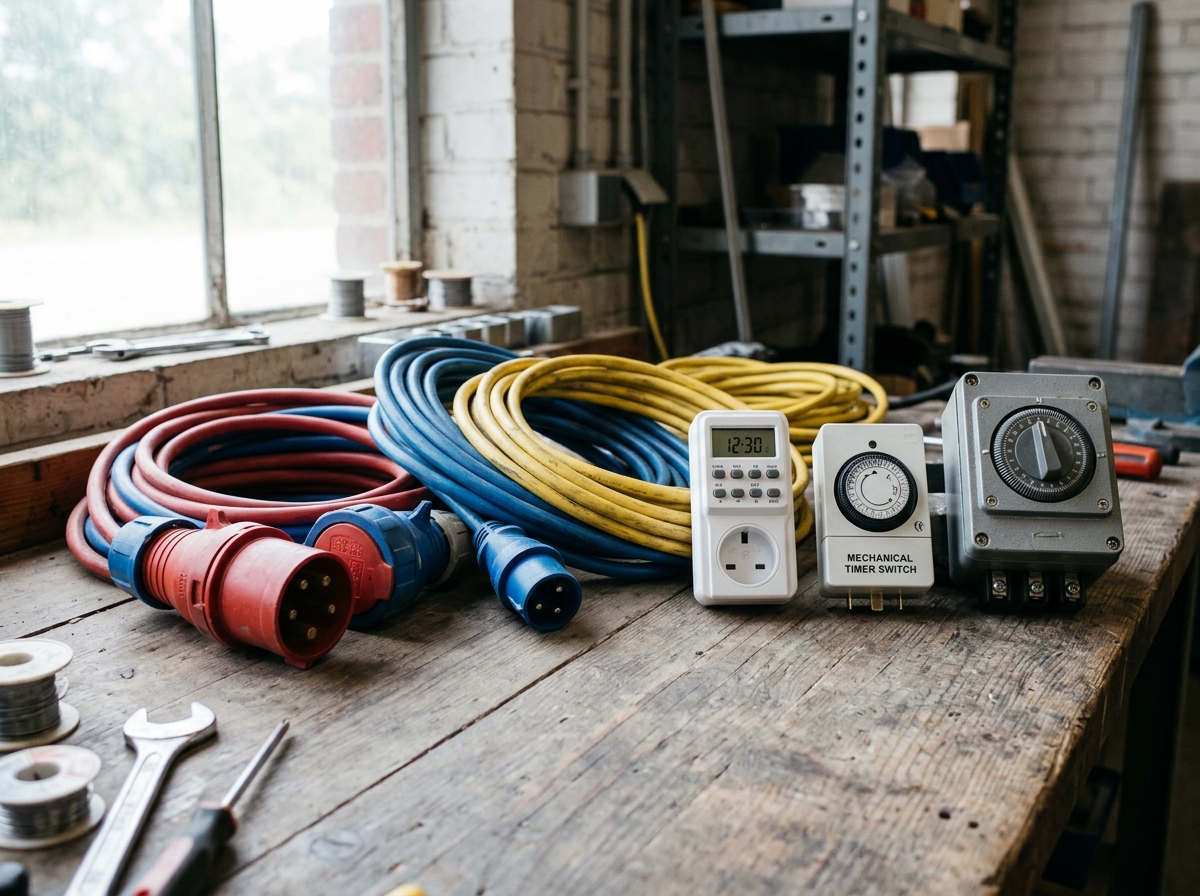 16A vs 32A: A Practical Purchasing Checklist
The fastest way to avoid a wrong purchase is to collect application data before comparing supplier quotations. A purchasing team should document the following information:
- Equipment model, rated input, operating mode, and starting characteristics.
- Supply voltage, frequency, phase, pole arrangement, and earthing requirement.
- Required current class: 16A or 32A, based on the equipment and installation design.
- Required cable length, expected movement, storage method, and routing conditions.
- Exposure to water, dust, oil, chemicals, sunlight, impact, and temperature changes.
- Connector type, required protection level, labeling, packaging, and destination-market requirements.
- Inspection, test documentation, sample approval, and replacement-part expectations.
For private-label or project procurement, request a sample and technical drawing before approving mass production. Confirm the plug and socket configuration, conductor construction, jacket marking, strain relief, terminal quality, packaging, and test records. This process is more reliable than comparing only catalog photographs.
Common Mistakes When Choosing an Industrial Extension Cord
The most common mistake is choosing a cord by current rating while ignoring voltage and connector configuration. A 16A label and a 32A label do not describe every electrical characteristic required for safe connection.
The second common mistake is using an extension cord that is too long for the equipment requirement. Length can affect voltage drop, handling, and heat management. The third is leaving a cable tightly coiled while operating a substantial load, which can reduce heat dissipation. The fourth is connecting damaged or contaminated plugs because the equipment still appears to function.
Another purchasing error is assuming that a higher-rated cord is always an upgrade. A 32A cord may be heavier, less convenient, and incompatible with a 16A outlet or machine. The correct product is the one that matches the complete electrical system and the working environment.
How Manufacturers Can Support Better Cord Selection
A capable supplier should provide more than a current label. Useful documentation includes conductor information, cable material, connector configuration, length options, environmental suitability, product drawings, test records, packaging details, and applicable market requirements.
Manufacturing capability also matters when a buyer needs private labeling, customized cable length, special connector combinations, retail packaging, or project quantities. A supplier with in-house development and testing can usually address design changes more systematically than a purely trading-based source, although buyers should still verify every claim through samples and documentation.
For international procurement, define acceptance criteria before production begins. Include visual inspection, dimensional checks, continuity and polarity checks where applicable, label verification, packaging inspection, and any destination-market testing required by the project. The exact test plan should be agreed with the responsible compliance professional.
FAQ
Is a 32A extension cord safer than a 16A extension cord?
Not automatically. A 32A cord can carry a higher nominal current class when the complete supply, protection, connector system, and equipment are designed for it. Safety depends on correct matching, installation, condition, and use.
Can I use a 32A cord with 16A equipment?
Only when the connector arrangement, voltage, protection, and equipment instructions permit the connection. A larger-rated cord does not remove the need to protect the lower-rated equipment and supply circuit.
Can a 16A cord power a motor?
It may be suitable if the motor manufacturer permits the connection and the cord can accommodate starting demand, operating conditions, length, and voltage-drop requirements. Check the equipment documentation rather than relying on running current alone.
Does a longer industrial extension cord need a larger conductor?
Not in every case, but length can increase voltage drop and affect heat and handling. The required construction should be selected from the actual load, supply, cable data, installation method, and acceptable voltage-drop criteria.
Is rubber better than PVC for every industrial application?
No. Rubber may be preferred for high-flex, outdoor, or construction conditions, while PVC can be appropriate for many general-purpose applications. The correct choice depends on temperature, abrasion, chemicals, flexibility, and exposure.
Can I connect multiple extension cords together?
Only when the equipment instructions, local requirements, and electrical design allow it. Connecting cords can increase voltage drop, create additional connection points, complicate protection, and increase trip or overheating risks.
What information should I send when requesting a quotation?
Provide the equipment rating, supply details, current class, connector configuration, cable length, environment, quantity, destination market, labeling, packaging, and required documentation. A complete specification helps the supplier recommend a verifiable configuration.
About the Manufacturer
Since 1986, Soyang Group has developed electrical connection and control products including timers, plugs, sockets, extension cords, cable reels, and cable-management accessories. Its capabilities include product development, testing, automated production, export-oriented documentation, and OEM or ODM support for industrial, retail, and engineering channels. Buyers can review the broader product range at the company website and submit application details for a tailored quotation.
Post time: Sep-18-2026